Investing in summer houses as a strategic business
Investing in summer houses in Denmark is a proven method for achieving both ongoing rental income and potential capital appreciation over time. By combining attractive tax deductions with stable demand from both Danish and international tourists, holiday homes can serve as a solid supplement to an investment portfolio. However, success requires thorough insight into lokalplaner (local district plans), maintenance, and market trends.
For decades, the Danish holiday home market has constituted a significant part of the national tourism economy. For the professional investor or the private buyer looking to professionalise their portfolio, it is not simply a matter of buying a property for personal use, but of viewing the summer house as a business unit. In this article, we delve into the mechanisms driving the market in September 2026 and look at how to navigate the legal and economic frameworks that characterise Denmark.
The Danish summer house market: Overview and trends in 2026
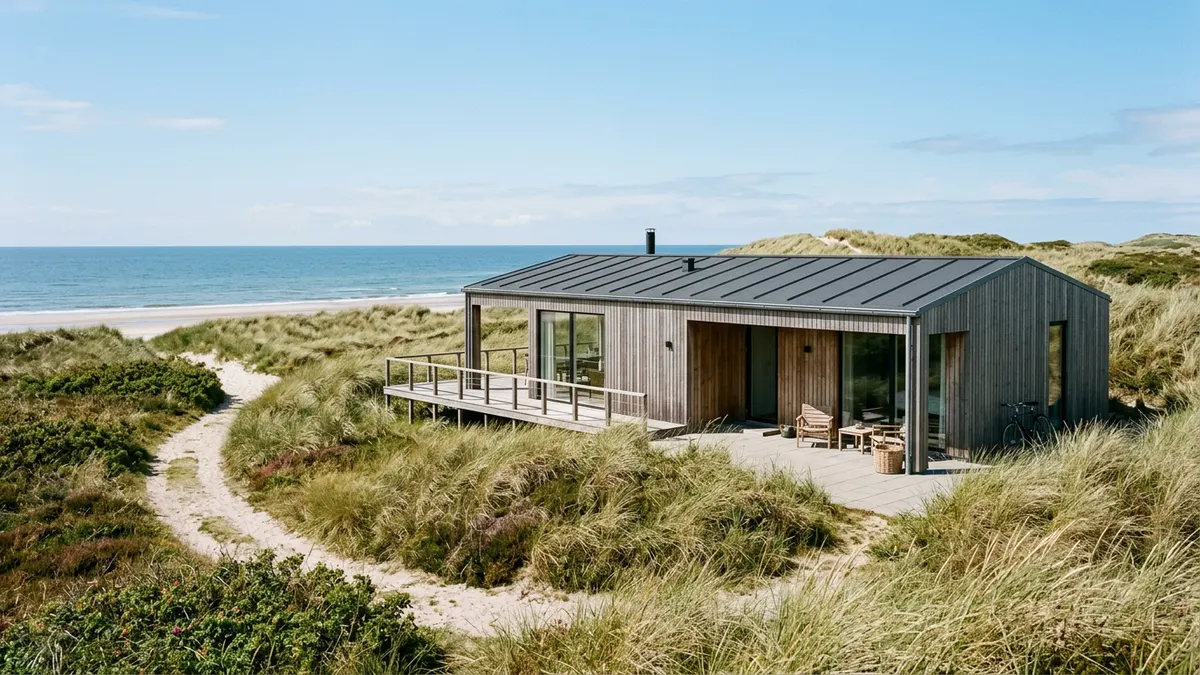
When discussing investing in summer houses, it is crucial to understand the geographical differences across Denmark. The country is divided into zones where demand and rental potential vary significantly. Historically, the Jutland west coast, particularly areas such as Blåvand, Henne Strand, and Søndervig, have been top performers in terms of rental weeks. This is largely due to the strong appeal to the German market, which values the wide sandy beaches and unspoilt nature.
Conversely, in Zealand, particularly in North Zealand around Hornbæk, Gilleleje, and Tisvildeleje, we see a market driven more by proximity to Copenhagen. Here, liggetider (time-on-market) are often shorter and square-metre prices higher, which can affect the direct yield but often results in historically stable value retention. The islands, such as Møn, Falster (Marielyst), and Bornholm, represent their own unique niches with varying season lengths.
A key trend in 2026 is the professionalisation of holiday home rentals. Today, tenants expect higher standards, high-speed internet, and energy-efficient solutions like heat pumps and EV chargers. Investors who manage to implement these elements often see a higher occupancy rate outside the peak season, which is key to a profitable business.
Tax rules and financing for summer house investment
One of the most attractive aspects of summer house investment in Denmark is the fiscal framework. There are basically two methods for taxing rental income: accounting-based assessment and the so-called 40% rule (fixed deduction).
Most private investors choose the 40% rule as it is administratively simple and often financially advantageous. Under this rule, a fixed bundfradrag (basic tax-free allowance) is granted, which is adjusted annually (check current rates at SKAT). Only 60% of the remaining rental income is taxed. This makes holiday home rentals one of the most tax-optimised forms of property investment for individuals. However, it is important to note that if you purchase the summer house through a company (e.g., an ApS (private limited company)), entirely different rules apply, and you must be aware of lagerbeskatning (mark-to-market taxation) and restrictions on personal use of the house.
In terms of financing, summer houses differ from year-round residences. Typically, you can finance up to 75% of the property's value with realkreditlån (mortgage credit loans). The remaining 25% must be financed via bank loans or equity. Interest rate developments at Nationalbanken (the Danish Central Bank) and general market conditions for mortgage bonds naturally play a major role in the ongoing liquidity of the investment.
| Financing Type | Loan-to-Value (Typical) | Security |
|---|---|---|
| Mortgage Credit Loan | Up to 75% | Charge on the property |
| Bank Loan | Typically 15-20% | Individual assessment |
| Equity | Minimum 5-10% | Cash deposit |
Note: The above is for guidance only. Always contact your financial institution or a financial advisor for specific calculations.
Choosing the right location (GEO-optimisation)
Location is the absolute most important parameter in any property investment. When investing in summer houses, however, you must distinguish between what you like personally and what can be rented out. An isolated forest cabin might be idyllic, but if it is two hours from shops and the beach, achieving high occupancy may be difficult.
The Jutland West Coast
Here, the season is long. German tourists often rent houses in the shoulder seasons (spring and autumn), providing a stable income over 25-35 weeks a year. Areas like Ringkøbing-Skjern and Varde Municipality are classic powerhouses for rentals.
North Zealand
Prices are high, and this is often where the largest gains from resale are seen. Rental potential is high during the summer holidays but can be lower in the winter months compared to the west coast, unless the house is exceptionally well-equipped (e.g., with a spa or pool).
Bornholm and the Islands
Bornholm has experienced a renaissance. Investing here requires insight into ferry capacity and local logistics. Marielyst on Falster is another example of an area with a massive concentration of summer houses and a well-developed infrastructure for holiday rentals.
Operations, maintenance, and rental agencies
As an investor, you must decide whether to handle the rental yourself or use an agency (e.g., Novasol, DanCenter, Sol og Strand, or local players).
Advantages of a rental agency:
- Marketing across international borders.
- Handling of key handover and final cleaning.
- Insurance schemes for damage caused by tenants.
- Larger tax-free allowance (when renting through an agency).
Advantages of self-management (e.g., Airbnb):
- No agency commission (typically 20-40%).
- Full control over who rents the house.
- Ability to adjust prices quickly.
However, it is worth noting that self-management requires significantly more time. Maintenance is another important item. Danish weather takes its toll on wooden houses. A fixed maintenance plan for painting, roof cleaning, and gardening is necessary to protect the asset's value. Investors should set aside a fixed percentage of rental income for ongoing improvements.
Optimising yield: What are tenants looking for?
To maximise your investment in summer houses, the property must be optimised for user needs. In 2026, we see a clear preference for:
- Energy optimisation: Houses with heat pumps and solar panels are cheaper to heat for the tenant (if they pay for consumption) or for the owner (if included). This makes the house attractive in winter months.
- Wellness facilities: A spa, sauna, and outdoor hot tub are no longer just luxuries but often an expectation in higher price brackets. This can increase rental income by 20-30%.
- Activity rooms: Table tennis, billiards, or gaming consoles make the house attractive for families with children, especially if the Danish summer weather fails.
- High-speed internet: With the rise of "workations" (combining work and holiday), stable fibre broadband is a critical parameter.
Legislation and restrictions
It is essential to know the Sommerhuslov (Summer House Act). In Denmark, there are rules on how much you can use your summer house for year-round living. As a starting point, a summer house is intended for holiday stays, and you may not live there permanently all year round unless you are a pensioner and have owned the house for a number of years (check specific rules with the Ministry of Justice).
Furthermore, you must be aware of the rules for foreigners purchasing real estate in Denmark. Persons without a residence in Denmark who have not previously lived here for 5 years must apply for permission from Civilstyrelsen (the Danish Civil Authority) to acquire a summer house. This is an important detail for international investors, which PropertyInvestments often advises on.
Risk analysis in property investment
No investment is without risk. For summer houses, you should consider the following:
- Economic sensitivity: Tourism is often one of the first things people save on during crises. However, the Danish market has proven robust, as Danes then tend to holiday at home.
- Climate change: Coastal properties may be vulnerable to storm surges or erosion. Always check the latest flood risk maps.
- Legislative changes: Tax rules can be changed politically. It is therefore important to base your calculations on conservative estimates.
Calculating the business case
When evaluating a potential investment in summer houses, you should prepare a budget that includes:
- Expected rental income (based on statistics from similar houses in the area).
- Property taxes and insurance.
- Utility charges (electricity, water, heating).
- Maintenance (approx. 1% of the property value annually).
- Commission to the rental agency.
- Financing costs.
A healthy yield on a Danish summer house typically lies between 4% and 8% before capital appreciation, depending on leverage and the operating model. By choosing properties with potential for modernisation (value-add), you can further increase your return through an increase in the value of the asset itself.
Strategies for portfolio expansion
For the serious investor, the journey rarely stops at the first house. A common strategy is to reinvest profits into additional units to achieve economies of scale. This may involve having several houses in the same geographical area to minimise travel time for inspections, or spreading across different parts of the country to reduce risks associated with local weather phenomena or regional changes in tourism.
Investing in summer houses requires patience. It is a long-term asset class where the greatest gains are often harvested over a period of 10-20 years, as debt is repaid and market prices rise in line with general inflation and demand for recreational space.
Final considerations
Running a holiday home rental as a business is a balancing act between hard-nosed financial calculation and an understanding of the guest experience. In a market like Denmark, characterised by safety, scenic surroundings, and a well-developed infrastructure, the foundation for a good investment is present. It is about doing your homework, understanding local conditions, and choosing properties that can stand the test of time.
Always remember to seek professional advice from accountants and lawyers before making major investments to ensure your specific situation is handled correctly in relation to current legislation.
Frequently asked questions
Is investing in summer houses a safe investment?
No investment is 100% safe, but the Danish summer house market has historically been very stable. Risk is minimised through good location and a sound financing structure. It is recommended to have a time horizon of at least 5-10 years.
How much can you earn from summer house rentals?
Earnings vary enormously depending on the house's size, facilities, and location. A well-located house with a pool can, in some areas, generate a turnover of 200,000 - 400,000 DKK annually, while smaller houses are lower. Profit depends on your operating costs and tax situation.
Can foreigners invest in Danish summer houses?
Yes, but it normally requires permission from the Civil Authority, unless you have a strong connection to Denmark or have lived here for a long period. Professional investors often use advisory services to navigate these rules.
What is the biggest mistake investors make?
Buying with the heart rather than the head. An investment property should be chosen based on rental potential and resale value, not necessarily personal taste in kitchen choices or garden layout. Another mistake is underestimating maintenance costs.
How PropertyInvestments can help
Since 1985, PropertyInvestments has assisted both Danish and international investors in finding and optimising property investments in Denmark. We offer expertise in sourcing opportunities that rarely hit the open market, and we can assist with preparing properties for sale or rental. Our approach is concrete and professional, with a focus on long-term relationships and results. If you are considering expanding your portfolio with an investment in summer houses, you are welcome to contact us for a non-binding dialogue about your options.
Contact: info@propertyinvestments.dk | +45 31 16 31 00