An energimærke til ejendom (property energy label) serves as a mandatory declaration of a building's energy consumption and efficiency, ranked from A to G. The purpose is to highlight operating costs and potential energy savings, which has a direct impact on the property's market value, financing options, and attractiveness to tenants and investors in the Danish market.
Understanding the significance of energy ratings for real estate
The energy rating is not merely a piece of paper to be completed during a sale. It is a strategic tool that provides an objective assessment of a building's energy condition. In Denmark, the scheme is managed under the Ministry of Climate, Energy and Utilities, and it is mandatory for almost all types of buildings when they are to be sold or rented. For an investor, an energy label means gaining insight into the hidden operating costs that can affect the property's net yield.
When looking at the property market in cities like Copenhagen, Aarhus, and Odense, there is a clear trend where properties with high energy classes (A and B) are traded at a premium compared to properties in lower classes. This is due not only to lower consumption costs but also to the fact that future legal requirements are expected to become stricter. By investing in a property with a good energy rating, you future-proof your investment against potential requirements for forced energy improvements.
It is important to note that the energy label consists of two parts: the energy class itself and an energy labelling report. The report contains suggestions for profitable energy improvements that the owner can carry out to enhance the property's profile. These recommendations are worth their weight in gold for an investor wishing to increase the property's value through active asset management.
Legal requirements and regulations for property energy labels
In Denmark, the rules for energy labelling are clear. As a rule, all buildings over 60 square metres must have a valid energy label upon sale or rental. There are certain exceptions, such as fredede bygninger (listed buildings) or temporary structures, but for the typical investment property—whether residential rental or commercial—it is a requirement.
An energy label is generally valid for 10 years. However, one should be aware that if significant changes are made to the building that affect energy consumption—such as replacing windows, retrofitting roof insulation, or installing a new heat source—a new label should be prepared to reflect the improved standard. This is particularly relevant in connection with the renegotiation of loans or an impending sale.
For multi-family houses and apartment blocks, special rules apply. Here, the entire building must be energy labelled as a whole, and it is the ejerforening (owners' association) or the landlord who is responsible for ensuring the label is up to date. For commercial properties, rules may vary depending on use, but the principle of transparency in energy consumption remains the same. Violation of the rules can lead to fines, and in the worst case, a buyer or tenant can claim compensation if the label is missing or erroneous.
How the energy class affects valuation
There is a direct correlation between a property's energy class and its market value. In the current 2026 market, we see that investors prioritise ESG factors (Environmental, Social, and Governance) higher than ever before. A property with an A2020 energy label is considered a "prime asset," while a property with an E or F label will often be met with a demand for a price reduction to cover expected renovation costs.
Financing and green loans
Danish mortgage institutions and banks are increasingly focused on green financing. Properties with good energy labels can often qualify for green bonds or loans with lower interest rates and better terms. This is because the risk is assessed as lower, as the property is cheaper to run and more resilient to energy crises. For a professional investor, a difference of 0.25% in interest margin can mean significant sums over a number of years.
Operating economy and tenant satisfaction
For residential rental properties in growth cities like Roskilde, Aalborg, or Esbjerg, the total housing expenditure (rent + consumption) is decisive for the tenants' ability to pay. If the heating bill is high due to poor insulation, it will put a damper on how much rent the tenant can or will pay. An energy-efficient property therefore allows the landlord to optimise rental income while minimising vacancy risk, as the homes are more attractive.
| Energy Class | Characteristics | Impact on Value |
|---|---|---|
| A2020 / A2015 | New build or fully renovated with renewable energy | Highest market value, lowest financing rate |
| B / C | Good insulation, modern windows and heat sources | Stable value, moderate risk |
| D | Acceptable condition, but often with potential for improvement | Market average, focus on optimisation opportunities |
| E / F / G | Poor insulation, old heating systems (e.g. oil) | Value discount, risk of legal requirements for upgrades |
Energy report recommendations as an investment strategy
One of the most overlooked advantages of a property energy label is the list of recommended improvements. This list is divided into measures that are profitable right now and measures that should be considered during renovation. For an investor, this serves as a roadmap for value creation.
Typical recommendations include:
- Retrofitting insulation of the building envelope: Insulating the attic, cavity walls, and floor slabs are often the most cost-effective measures with short payback periods.
- Window optimisation: Upgrading from 2-pane to 3-pane energy-efficient glazing can significantly improve the indoor climate and reduce heat loss.
- Technical installations: Converting from gas boilers to heat pumps or connecting to fjernvarme (district heating) (where possible in regions like Zealand or Jutland) are central elements in the green transition.
- Ventilation: Installing heat recovery systems can both lower energy consumption and improve the building's health by removing moisture.
By implementing these suggestions systematically, an investor can move a property from, for example, energy class D to B. This journey not only creates savings on operations but also lifts the property's "yield" through a combination of lower costs and a higher valuation upon an eventual exit.
Regional differences and market trends in Denmark
Although the rules for energy labelling are national, their significance varies depending on geography. In major cities like Copenhagen and Aarhus, where property prices are high, energy consumption accounts for a relatively smaller portion of the total ownership costs, but ESG requirements from institutional investors are, conversely, very strict. Here, a high energy label is often a prerequisite for selling to pension funds or foreign funds.
In smaller towns in the Region of Southern Denmark or North Jutland, where property prices are lower, the actual heating cost takes up more of the tenant's budget. Here, a property with an energy label of F can be outright difficult to rent out if the heating bill exceeds a certain percentage of income. Therefore, we often see that the value added by energy renovation is percentage-wise higher in the provinces than in the capital area, as you move from "unrentable" to "attractive."
It is also worth mentioning political developments. The EU's Energy Performance of Buildings Directive (EPBD) suggests that member states should phase out the worst energy labels in the existing building stock over the coming years. Although specific Danish implementation requirements are continuously adjusted, the direction is clear: buildings with low energy efficiency will be subject to restrictions or renovation requirements. One should therefore always consult the latest announcements from the Ministry of Justice or SKAT (the Danish Tax Agency) regarding property taxation and legal requirements, as these factors interact with energy labelling.
Technical walkthrough: How an energy label is prepared
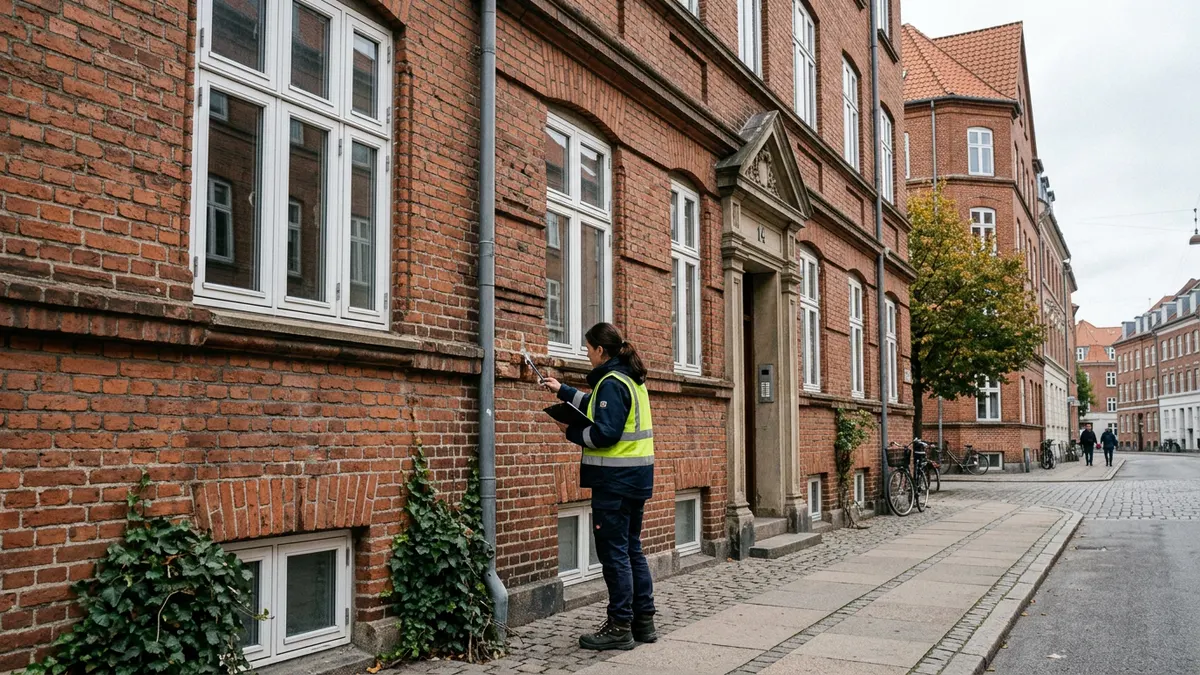
The preparation of an energy label must be carried out by a certified energy consultant. The process involves a physical inspection of the property, where the consultant measures the building and records everything from insulation thickness to the type of light sources. Data is entered into a central system, which calculates the building's theoretical energy consumption under standardised conditions.
It is important to understand that the energy label is based on the building's technical condition—not on the current user's actual consumption. A family of five who takes long showers and keeps every room at 23 degrees will have a higher actual consumption than a single person who saves on heat, even if they live in identical houses with the same energy label. This ensures that buyers and investors can compare buildings on a uniform basis.
For investors, it is crucial to ensure that the consultant has access to all relevant documentation, including drawings, information on completed renovations, and technical specifications of the heating system. The better the documentation, the more accurate the label becomes. Lack of documentation often leads to the consultant having to choose conservative default values, which can result in a poorer energy class than the property actually deserves.
ESG and the future investment landscape
ESG (Environmental, Social, Governance) has moved from being a buzzword to being the foundation of professional real estate investment. The energy label is the core of the "E" (Environmental). When looking at transactions in 2026, buyer due diligence is heavily focused on the property's climate footprint.
Foreign investors entering the Danish market often look at the property energy label as the first key performance indicator. They need to report to their investors on the portfolio's total CO2 emissions. A property with a poor label drags down the average and can become a liability for the overall portfolio. This has created a market where "brown discounting" (price reductions on non-green properties) is a reality.
Therefore, it is always recommended to seek professional advice from energy consultants and investment advisors before making major upgrades. It is about finding the right balance between the investment cost and the resulting increase in value. Sometimes it is more profitable to achieve a solid class C than to spend disproportionate amounts of money to hit class A, depending on the property type and location.
Summary of the value chain
The effect of a strong energimærke til ejendom can be summarised in the following points:
- Higher sales price: Buyers are willing to pay more for documented low operating costs.
- Better financing: Access to advantageous green loans and lower interest rates.
- Lower vacancy: Residential and commercial units are easier to rent out when consumption costs are low.
- Risk minimisation: Protection against future legal requirements and energy crises.
- ESG compliance: Makes the property attractive to institutional and international investors.
In a time of uncertain energy prices and increased focus on sustainability, the energy label is not just a bureaucratic necessity but a central part of the property's business plan. Whether operating in Copenhagen, Odense, or smaller towns in Jutland, understanding energy optimisation is the key to a healthy return.
Note: This article does not contain legal or tax advice. Rules for energy labelling, subsidy schemes, and tax conditions may change. We always recommend consulting relevant professional advisors, including energy consultants, accountants, and lawyers, before making decisions on investment or renovation. For updated rules, refer to the Danish Energy Agency and the Ministry of Climate, Energy and Utilities.
Frequently asked questions
How long is a property energy label valid for?
An energy label is generally valid for 10 years from the date it is issued. However, if significant changes are made to the property that affect energy consumption, a new label should be prepared to ensure the documentation reflects the current state.
Is it mandatory to have an energy label when renting out?
Yes, it is a legal requirement that the landlord presents a valid energy label to the tenant before the lease agreement is entered into. This applies to both residential and commercial premises, unless the building is exempt (e.g. certain small buildings or listed properties).
Can you improve your energy class yourself?
Yes, you can improve the energy class by implementing energy-saving measures such as retrofitting insulation, replacing windows, or optimising the heating system. To have the new class officially registered, a certified energy consultant must prepare a new label.
How much does it cost to get a property energy label?
The price depends on the size and type of the property. Maximum prices are set for the energy labelling of smaller homes, while the price for larger apartment blocks and commercial buildings is typically agreed upon individually based on time spent and the complexity of the task.
How PropertyInvestments can help
At PropertyInvestments, we have helped Danish and international investors navigate the Danish property market since 1985. We source and analyse investment properties, where we assess, among other things, the potential of the energy label as part of our due diligence.
If you are looking for advice on buying, selling, or optimising investment properties, you are welcome to contact us for a professional dialogue about your options. We ensure that all processes—from sourcing to the final sale—are handled professionally and with a focus on creating long-term value.
Contact us at info@propertyinvestments.dk or telephone +45 31 16 31 00.