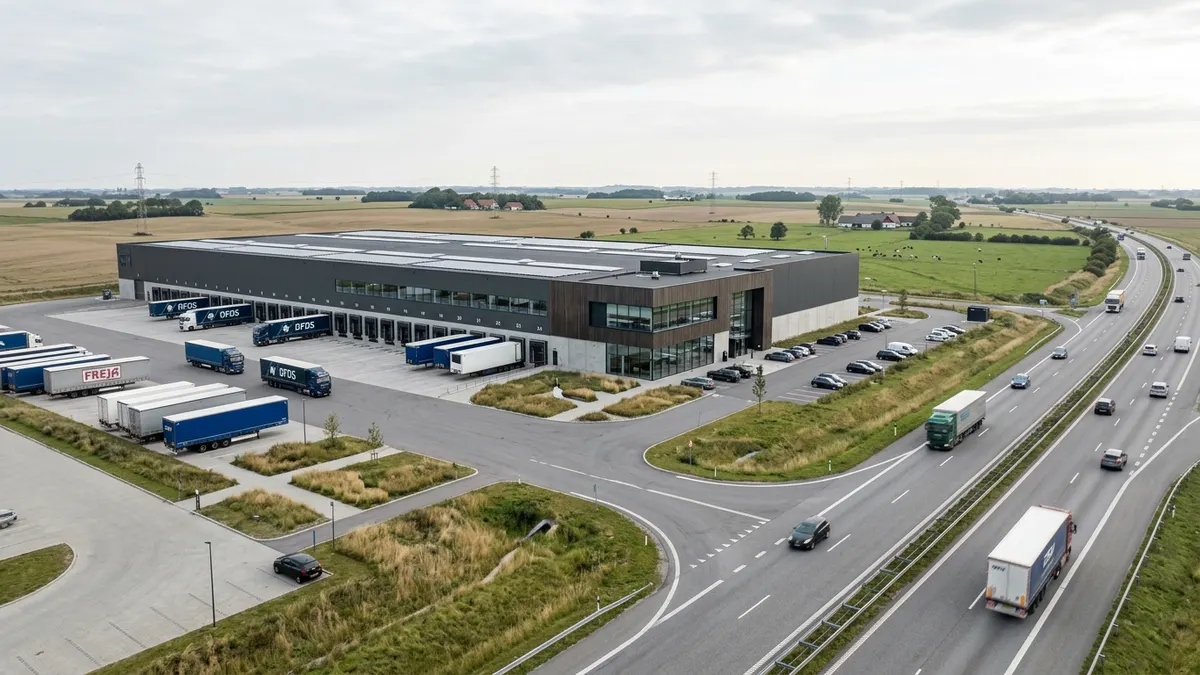
Logistics property investment in 2026 is characterised by massive demand driven by the continued growth in e-commerce and the need for efficient supply chains. Investors are looking towards modern warehouse facilities with strategic locations near motorway networks and urban areas to optimise 'last mile' delivery, ensuring stable returns and low vacancy rates in the Danish market.
Market developments for logistics properties in 2026
The Danish market for logistics and warehouse properties has undergone a significant transformation over the past decade. Where warehouse buildings were previously often regarded as simple, secondary property types, they have today become one of the most sought-after asset classes for both institutional and private investors. This fundamental change is primarily due to a structural shift in consumption patterns.
E-commerce has not just changed the way we shop; it has changed the requirements for the physical infrastructure that supports trade. A webshop typically requires three times as much warehouse space as a traditional physical store, as the entire stock must be available centrally rather than being distributed across store branches. This has created sustained pressure on the supply of modern facilities, making logistics property investment a central topic in the real estate industry.
In September 2026, we see that requirements for properties have tightened. It is no longer enough just to have four walls and a roof. Investors and tenants now demand properties with high-ceilinged halls, advanced ventilation systems, and an infrastructure that can handle automated warehouse management and robotics. Technological integration has become a decisive factor for the property's value and future-proofing.
E-commerce as the primary growth engine
The explosive growth in e-commerce has created a need for different types of logistics facilities. Today, we often distinguish between large central warehouses and smaller, urban distribution centres. Both types play a critical role in the modern supply chain.
Central warehouses are often located at major traffic hubs, where they function as receiving stations for large quantities of goods. Here, the focus is on volume, efficiency, and access to the motorway network. In these areas, we often see properties with a ceiling height of 12 metres or more, allowing for maximum utilisation of square footage through high-bay racking systems.
Distribution centres, or 'last mile' hubs, are located closer to major cities such as Copenhagen, Aarhus, Odense, and Aalborg. The purpose here is to ensure fast delivery to the end customer. As consumers in 2026 expect same-day delivery or delivery within a few hours, proximity to the customer has become one of the most important parameters. This has led to increasing interest in transforming older industrial properties in urban areas into modern logistics facilities.
Strategic locations for logistics property investment
When considering a logistics property investment in Denmark, location is the most critical factor. Denmark serves as a logistical bridge between Scandinavia and the rest of Europe, making certain regions particularly attractive.
The Triangle Region: Denmark's logistical heart
The cities of Vejle, Kolding, and Fredericia together make up the Trekantområdet (Triangle Region), which historically and currently is the country's most important hub for transport. With the intersection of the E20 and E45 motorways, the area is ideal for companies that need to distribute goods across the entire country and Northern Germany. Demand here is constantly high, and the vacancy rate for modern premises is minimal.
Zealand and Greater Copenhagen
Around Copenhagen, the challenge is the lack of building plots. This has driven investors towards areas like Køge, Høje-Taastrup, and Greve. Køge, in particular, has developed into a logistical powerhouse due to the port expansion and direct connection to the motorway network heading south. Investment in these areas is often characterised by higher prices per square metre, but also by a very low risk of vacancy.
East Jutland and the Nordic axis
The Aarhus area and up towards Randers and Aalborg are also experiencing great growth. With Aarhus Port being one of the Nordic region's largest container ports, there is a natural need for hinterland logistics. The logistics axis along the E45 is the backbone of Jutland's goods transport and attracts investors who want exposure to both industry and trade.
Technical specifications and modern requirements
A modern logistics property in 2026 must meet a number of technical requirements to remain attractive to tenants over a longer period of years. Here are some of the most important factors:
- Ceiling height: Modern logistics requires volume. A clear height of minimum 10-12 metres is standard for new builds.
- Floor load capacity: Automated warehouse systems and heavy racking installations require floors with high load-bearing capacity and precise flatness.
- Number of gates: Efficient loading and unloading is crucial. There must be a sufficient number of docks and gates in proportion to the size of the property.
- Outdoor areas: Space for manoeuvring modulvogntog (modular vehicle combinations/LHV - 25.25m) and parking for distribution vans is an often overlooked but critical factor.
- Sustainability: Certifications like DGNB have become standard. Solar panels on large roof surfaces and energy-efficient lighting are not only good for the environment but also for the tenants' operating costs.
Overview of key factors for logistics properties
| Factor | Description | Investor Focus |
|---|---|---|
| Location | Proximity to E20/E45 and urban hubs | Ensuring re-letting potential |
| Ceiling height | Typically 10-12+ metres clear height | Optimisation of storage capacity per m2 |
| Energy optimisation | Solar panels, LED, heat pumps | Reduction of operating costs and ESG profile |
| Infrastructure | Access for modular vehicle combinations | Operational efficiency for the tenant |
| Flexibility | Option to divide into smaller units | Risk diversification during tenant turnover |
Economic aspects and yields in logistics property investment
The return on logistics properties has historically been higher than on office and residential properties, as the risk was considered greater. In 2026, yield requirements have, however, fallen somewhat, as the asset class is now considered safer due to the structural growth in e-commerce. Nevertheless, these are still attractive investments compared to many other asset classes.
In a logistics property investment, one must be aware of the duration of the contracts. Typically, the market operates with longer non-terminable periods than in the office sector, often 5, 10, or even 15 years, especially if the property is custom-fitted for the tenant. This provides a predictable cash flow, which is attractive to long-term investors.
However, it is important to factor in maintenance of large surfaces (roofs and facades) as well as any requirements for upgrading technical installations. Investors should always consult professional advisors to review specific lease agreements and the property's technical condition through a Technical Due Diligence.
Risk management and future-proofing
Although the market is strong, there are risks that must be addressed. One of the greatest risks is the property's relevance over time. A logistics property built for one specific purpose or one specific tenant can be difficult to re-let if it is not flexible.
Flexibility is key. When constructing or purchasing properties, one should ensure that the building can easily be divided into smaller sections, or that the layout can be changed without massive investments. This is often referred to as 'multi-tenant' potential.
Another significant factor is legislation and environmental requirements. Regulations from the EU and national authorities regarding energy efficiency and carbon footprint are continuously tightened. A property that does not meet future requirements may risk becoming a 'stranded asset' – a property that is difficult to sell or finance. It is always recommended to stay updated via official channels such as Energistyrelsen (Danish Energy Agency) or relevant industry organisations.
Legal and tax considerations
Investment in commercial real estate in Denmark is subject to specific rules in the Erhvervslejeloven (Business Buildings Lease Act). Unlike the residential tenancy act, there is a high degree of freedom of contract here, which means the contract is the most important document. Investors should seek legal assistance to ensure that maintenance obligations, ejendomsskatter (property taxes), duties, and indexation of rent are handled correctly.
Tax-wise, there may be a difference whether you invest as an individual or through a company. There are rules for depreciation on commercial buildings, which can have a major impact on the total return after tax. As tax rules are complex and can change, you should always consult an accountant or tax advisor specialising in real estate. Information on current tax rates and rules can be found on the SKAT (Danish Customs and Tax Administration) website.
Market trends towards 2030
Looking ahead, automation and AI will play an even greater role in logistics. We are already seeing trends towards 'dark warehouses' – fully automated warehouses where there is virtually no human activity. This places entirely new demands on power supply and cooling for server rooms within the properties.
Furthermore, we will see increased integration of transport modes. Proximity to rail terminals could become an important differentiator as companies seek to reduce their carbon footprint by moving freight from road to rail. Investors who manage to identify properties with access to multiple modes of transport (multimodal transport) will stand strong in the future market.
Conclusion
Logistics property investment in September 2026 is a mature and robust asset class in the Danish real estate market. Driven by fundamental changes in consumer behaviour and technological advances, the sector offers interesting opportunities for investors who understand the importance of location, technical specifications, and flexibility.
Denmark's geography as a Nordic logistics hub ensures continued relevance, but success requires thorough due diligence and an understanding of the rapid shifts in tenant needs. With the right approach and professional advice, logistics properties can constitute a solid cornerstone in a diversified investment portfolio.
Frequently asked questions
What is the typical yield on a logistics property investment?
The yield varies depending on location, the age of the property, and the tenant profile. In general, yields for logistics often lie slightly higher than for residential properties, but in the most popular areas like the Triangle Region, yield requirements are pushed down due to high demand. Contact a commercial broker or advisor for specific market data.
Is it best to invest in new or older warehouse properties?
New properties meet modern requirements for ceiling height and energy, minimising the risk of vacancy. However, older properties can often be purchased at a lower price and, with the right modernisation, can provide a high return, especially if they are located close to major cities.
How does e-commerce affect the need for warehouse space?
E-commerce requires significantly more warehouse space than traditional retail, as the entire range must be stored and handled in one place. Furthermore, returns handling and pick-and-pack processes require extra square footage compared to simple pallet storage.
Which cities are most attractive for logistics in Denmark?
Kolding, Fredericia, and Vejle (the Triangle Region) are the primary hubs. Additionally, Køge, Høje-Taastrup, Aarhus, and Aalborg are highly sought-after locations due to their placement relative to the motorway network and ports.
How PropertyInvestments can help
PropertyInvestments has been active in the Danish real estate market since 1985. We offer comprehensive consultancy within logistics property investment, including sourcing suitable properties, optimising existing portfolios, and assistance throughout the entire sales process.
Whether you are a Danish investor or represent a foreign private equity fund, our specific market knowledge can help identify the right opportunities in the Danish logistics landscape. We focus on objective advice and long-term relationships.
For a non-committal dialogue about your opportunities in the market for logistics and warehouse properties, you are welcome to contact us at info@propertyinvestments.dk or by telephone at +45 31 16 31 00.