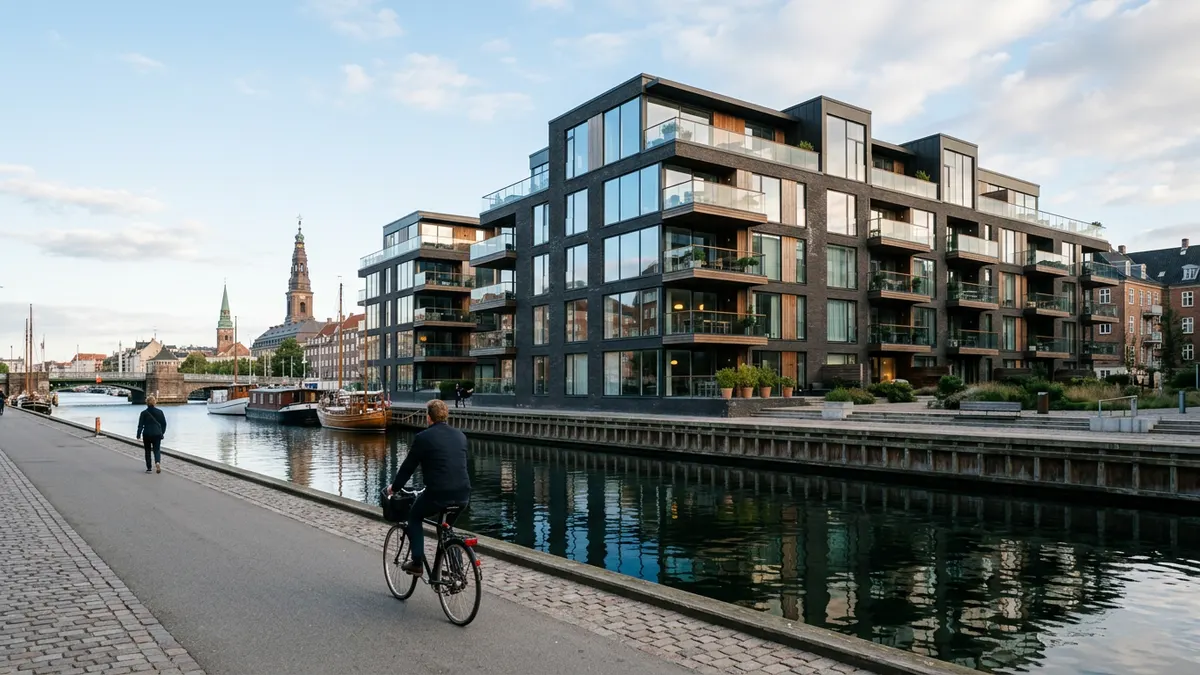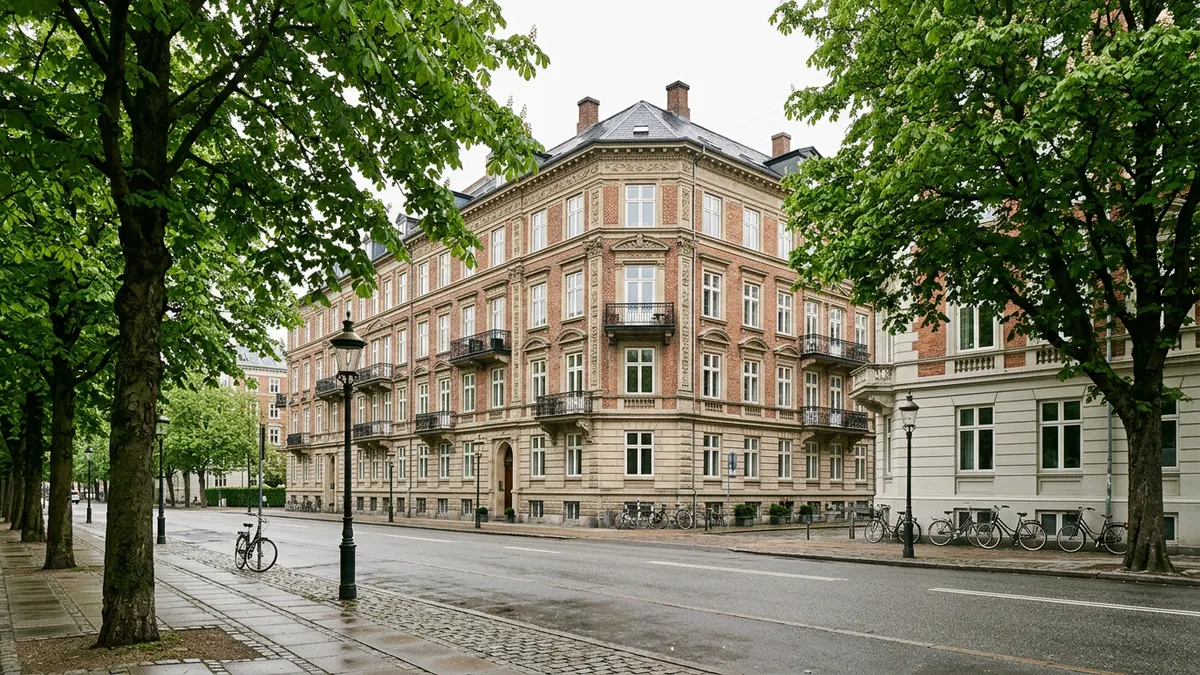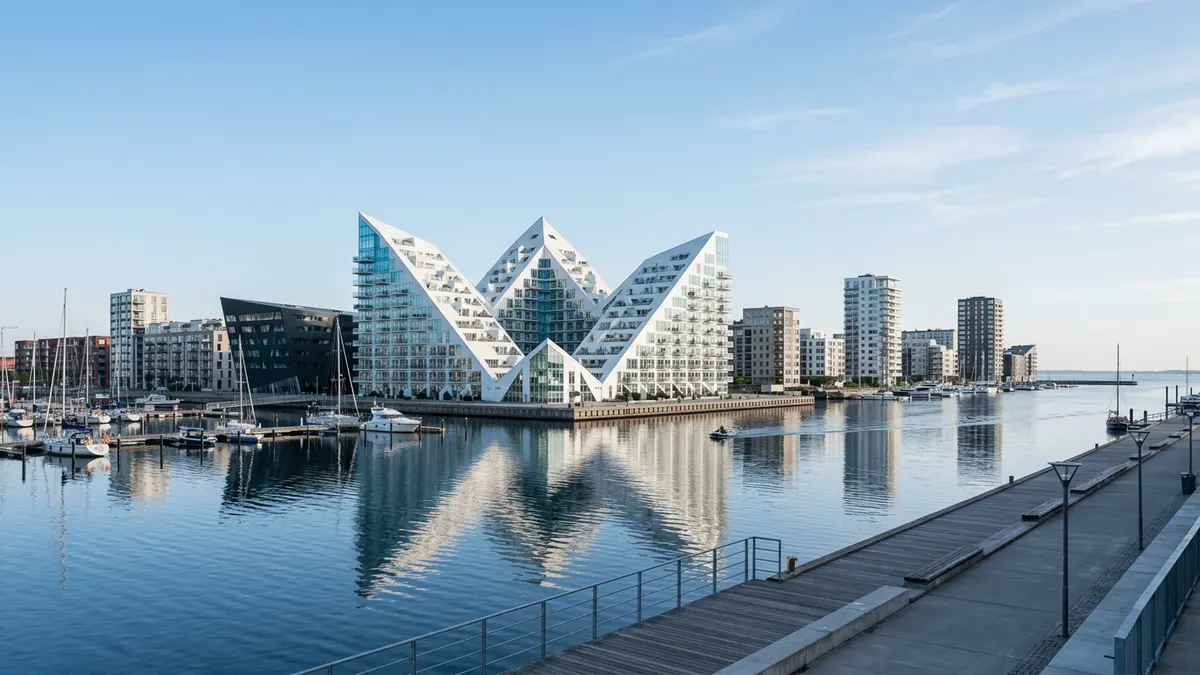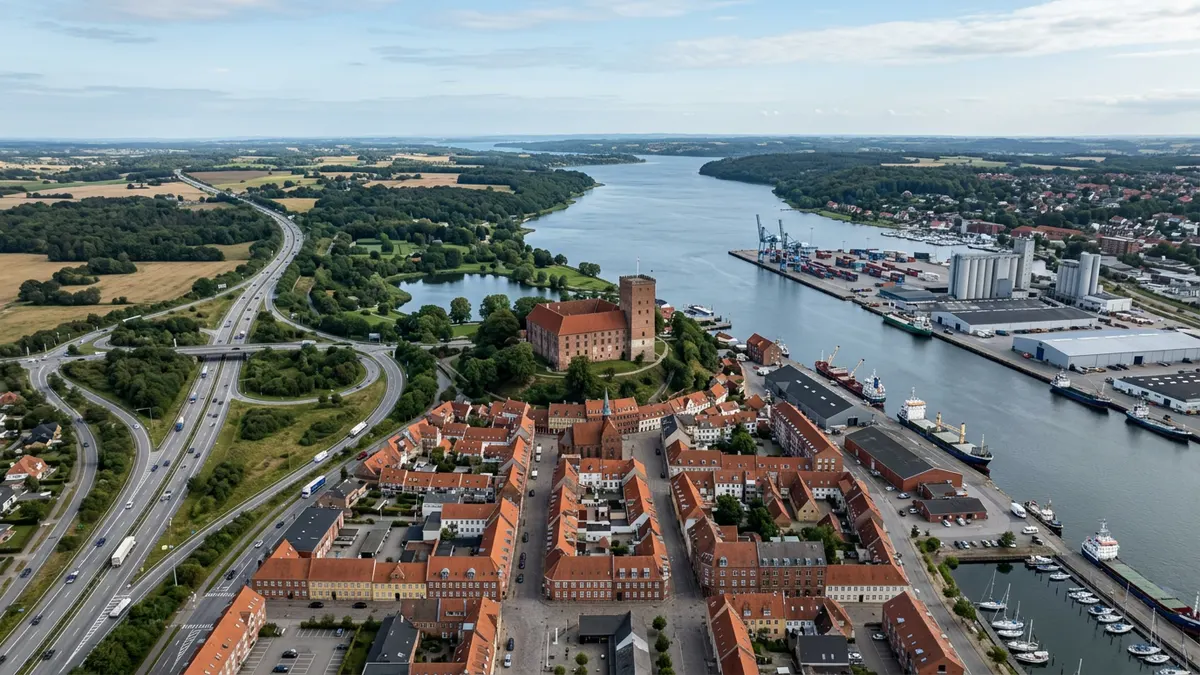
An investment property in Kolding is an attractive asset class due to the city's central location in the Trekantområdet (Triangle Area). With direct access to the E20 and E45 motorways, Kolding offers optimal conditions for logistics and commercial real estate, while steady population growth and status as an educational hub ensure stable demand for residential rental properties for both families and students.
Kolding as a strategic hub in the Triangle Area
When discussing investment property in Kolding, it is impossible to ignore the city's geographical position. As part of the Triangle Area, which also includes Vejle and Fredericia, Kolding forms the heart of Denmark's logistical infrastructure. The city serves as a bridge between Northern Germany, Aarhus, and Copenhagen, making it one of the country's most sought-after locations for companies reliant on efficient distribution.
This unique position means that commercial areas on the outskirts of the city, close to motorway exits, have experienced significant value appreciation over recent decades. For an investor, this means the risk of vacancy in well-located logistics properties is often lower than in less centrally located provincial towns. The infrastructure is further supported by the Port of Kolding, which adds a maritime dimension to the city's logistical capacity, relevant for heavy industrial companies and bulk transport.
Simultaneously, Kolding has evolved from a traditional industrial town into a knowledge centre. With the University of Southern Denmark (SDU) and Design School Kolding, the city has attracted a young and dynamic demographic. This shift has created a varied need for different types of investment properties – from large warehouses to modern office facilities and student housing in the city centre.
Residential letting: Stable demand in a growth city
Investing in residential properties in Kolding follows a stable trend driven by both urbanisation and local business development. The city is experiencing a steady influx of new citizens, creating a sustained need for rental housing. It is particularly interesting to look at the market segmentation.
Family homes and terraced houses
On the outskirts of Kolding, in areas such as Bramdrupdam, Vonsild, and Seest, demand for terraced houses and detached houses for rent is high. Families move to Kolding to get more space than in cities like Aarhus, while maintaining good commuting options. The investment case here often involves long-term tenants and low maintenance costs for newer builds.
Student housing and small apartments
Kolding C (Central) houses a large number of students. The demand for 1- and 2-bedroom apartments is therefore significant, especially around the start of the academic year in August and September. As an investor in this type of investment property in Kolding, one must be aware of higher tenant turnover (churn), which places greater demands on administration and ongoing maintenance of the units.
Senior housing
As in the rest of Denmark, we see a trend in Kolding where the mature segment wishes to swap their large villa for a centrally located apartment with an elevator and balcony. This segment prioritises quality and proximity to cultural offerings such as Koldinghus and Trapholt, making development projects in the city centre highly relevant for professional investors.
Commercial and logistics: The backbone of the Kolding market
Kolding is known as the "Logistics City," and for good reason. The areas around Kolding North and Kolding South are dominated by large logistics centres and transport companies. For an investor seeking an investment property in Kolding within the commercial sector, several factors apply:
- Lease security: Large logistics companies often sign long-term leases (10-15 years), providing a high degree of cash-flow security.
- Scalability: Land plots in commercial areas often allow for expansion, which can increase the property's value over time.
- Technical requirements: Modern logistics require high ceilings, numerous loading bays, and reinforced floors. Older properties may require significant modernisation to remain relevant.
A comparison of different commercial property types can be outlined as follows:
| Property Type | Primary Target Group | Typical Yield Range | Risk Profile |
|---|---|---|---|
| Logistics/Warehouse | Transport firms, E-commerce | Stable | Low to medium |
| Office (City Centre) | Consultants, creative sectors | Varying | Medium |
| Retail | Retail chains, local business | Competitive | Medium to high |
| Residential Letting | Private households | Stable/Low | Low |
Note: Yields vary according to location, condition, and market conditions. Contact an agent or advisor for updated figures.
Legislation and framework for property investment
When investing in real estate in Denmark, and specifically in an investment property in Kolding, there are a number of legal aspects to navigate. Lejeloven (The Rent Act) and boligreguleringsloven (The Housing Regulation Act) are the two primary sets of rules dictating how rent can be set and what duties you have as a landlord.
In Kolding, it is important to distinguish between properties built before and after 1991, as the rules for fri fastsættelse af leje (unregulated market rent) vary significantly between them. For older residential properties, rent is often regulated according to det lejedes værdi (value of the rented premises) or omkostningsbestemt leje (cost-based rent). We always recommend that investors seek specialised legal assistance from lawyers specialising in property law to ensure compliance with current rules from the Ministry of Justice and relevant agencies.
Tax-wise, there is also a difference whether you invest as a private individual or through a company (e.g., an ApS (Private Limited Company) or A/S (Public Limited Company)). Depreciation rules for commercial properties can provide tax benefits, while residential properties typically cannot be depreciated. Here, one should consult an accountant to optimise the investment structure in relation to SKAT (Danish Customs and Tax Administration) current rules.
Market development and future prospects in South Jutland
Kolding is not an isolated island but part of a larger regional growth engine. Development in nearby cities like Fredericia, Vejle, and Haderslev also affects the property market in Kolding. The planned expansion of infrastructure and green energy in the region is expected to create even more jobs, which in turn will increase the need for both commercial and residential square footage.
Within commercial real estate, we see an increasing demand for ESG-certified buildings (Environmental, Social, and Governance). Investors and tenants are increasingly focused on energy efficiency and sustainability. An investment property in Kolding optimised with solar panels, heat pumps, and modern insulation will likely stand stronger in re-letting situations and upon potential resale.
Financing an investment property in Kolding
The financing landscape in Denmark is characterised by the unique realkreditsystem (mortgage credit system), which offers some of the world's most stable financing options for real estate. When purchasing an investment property in Kolding, financing will typically consist of a combination of equity, realkreditlån (mortgage credit loans), and potentially bank financing.
For commercial properties, mortgage credit institutions typically provide loans for up to 60-70% of the property's value, while the figure for residential rental properties can be up to 80%. The credit assessment will be based on the property's Net Operating Income and the tenant's creditworthiness. In periods of fluctuating interest rates, it is crucial to have a robust financial plan that can withstand rate changes. Investors should stay informed via Finanstilsynet (The Danish Financial Supervisory Authority) and their financial institutions regarding current lending terms and capital requirements.
Due Diligence: The path to a secure investment
Before signing a købsaftale (purchase agreement) for an investment property in Kolding, a thorough due diligence process is essential. This involves a review of:
- Technical conditions: Condition assessment of roofs, facades, installations, and energimærke (energy labels).
- Legal conditions: Review of leases, servitutter (easements/covenants), local plans, and any pending cases.
- Financial conditions: Verification of operating expenses, rental income, and ejendomsskatter (property taxes).
- Environmental conditions: Investigation for soil contamination, asbestos, or other environmental liabilities, which is particularly relevant in older industrial areas of Kolding.
Insufficient due diligence can lead to unforeseen expenses that can quickly erode the return on an otherwise promising investment.
Summary of the investment climate
Kolding offers a rare combination of historical stability and modern growth potential. Whether focusing on the major logistics lines along the motorway or the charming cobbled streets in the centre, there are opportunities for both the conservative and the more growth-oriented investor. The city's ability to attract both large corporations and young students creates a diversified economy that makes the property market resilient to economic fluctuations.
However, it requires local knowledge and a professional approach to find the right opportunities before they become widely known on the market. Off-market transactions play a significant role in Kolding, where many of the best investment properties change hands without ever hitting public portals.
Frequently asked questions
Is Kolding a good city for first-time investors?
Yes, Kolding offers a good balance between price and risk. Smaller residential rental properties or apartments for let can be a good starting point, as the market is more accessible than in Copenhagen and Aarhus, but still maintains high liquidity.
Which areas in Kolding are most attractive for logistics?
Primary areas are near motorway junctions Kolding West and Kolding North. Here, the infrastructure is geared for heavy traffic, with short distances to both north-south and east-west transport arteries.
How does student life in Kolding affect the property market?
Student life creates constant demand for smaller rentals in the city centre. This means low vacancy rates for small apartments, though landlords should expect more administration due to more frequent move-ins and move-outs.
What rules apply to rent control in Kolding?
Kolding Municipality follows the general Danish rules in Lejeloven. Whether a property is subject to omkostningsbestemt leje (cost-based rent) depends on the property's age and character. We always recommend obtaining a specific rent assessment from a professional advisor.
How PropertyInvestments can help
Since 1985, at PropertyInvestments, we have helped investors find, analyse, and acquire the right properties across Denmark, including in the strategically important Kolding. We source both publicly listed properties and off-market opportunities through our extensive network. Our process includes everything from initial screening and valuation to assistance during due diligence and the final tinglysning (land registration).
Whether you are a private investor seeking your first investment property in Kolding or represent an institutional investor focused on larger logistics portfolios, we are ready with professional and objective advice. Contact us at info@propertyinvestments.dk or telephone +45 31 16 31 00 for a non-binding dialogue about your investment goals.