Investing in senior housing is a strategic real estate investment based on demographic trends in Denmark, where the number of elderly citizens is rising significantly. By focusing on modern, accessible homes and co-housing communities, investors can achieve stable rental income and low vacancy rates through an asset class that is undersupplied in both major cities and growth municipalities.
The demographic driver behind senior housing investment
The Danish property market in 2026 is at a turning point, where fundamental demographic shifts dictate housing demand. When discussing investment in senior housing, it is not merely a passing trend but a necessary adaptation to a reality where the Danish population is ageing. Data from Danmarks Statistik (Statistics Denmark) has long indicated that the group of citizens over 65 will grow significantly leading up to 2040, creating massive pressure on the existing housing supply.
Historically, property developers have focused on youth housing and family homes in major growth cities. However, as the large cohorts from the 1940s and 1950s now seek to move away from large, high-maintenance detached houses, a vacuum is emerging. This group of seniors is often affluent, with significant wealth tied up in their current homes, and they demand a specific type of housing that combines privacy with security and social communities.
For the professional investor, this means the risk of vacancy is reduced, as demand for well-located senior housing often exceeds supply. This applies not only to Copenhagen and Aarhus but also to secondary cities and suburban municipalities, where seniors wish to remain in their local area but in a more contemporary setting.
Geographical hotspots for senior housing in Denmark
Location choice is crucial for success in senior housing investment. Unlike students, who often seek the city centre, seniors prioritise accessibility to nature, shopping, and healthcare facilities, while also wanting proximity to infrastructure that makes it easy for family to visit.
The Capital Region and Zealand
In the Capital Region, we see a trend of seniors moving towards municipalities like Gentofte, Rudersdal, and Hørsholm, but also towards new urban development areas in Copenhagen's Sydhavn and Nordhavn. Here, the willingness to pay is high, as are the demands for quality and architecture. Elsewhere in Zealand, cities like Roskilde, Køge, and Ringsted are interesting, serving as hubs for a large portion of the surrounding elderly population.
The Jutland Growth Belt
In Jutland, Aarhus is naturally a powerhouse, but we also see strong interest in senior housing investment in cities like Silkeborg, Skanderborg, and Vejle. These cities combine scenic surroundings with an active urban life, which is exactly what the modern senior demands. The Triangle Region in general is attractive due to its central location in the country and excellent transport links.
Funen and major provincial cities
Odense has undergone a transformation, and senior housing in the city centre has become a sought-after asset. Cities like Svendborg, which have traditionally attracted a mature audience due to their maritime qualities, also stand out as strong investment cases.
Types of senior housing: From accessible apartments to co-housing
The term "senior housing" covers a wide spectrum of property types. It is vital for investors to understand the differences, as they require different operating models and target different segments of the elderly population.
- Senior-friendly apartments: Standard rental units built according to BR18 (Building Regulations) with a focus on full accessibility, lifts, wide doors, and no doorsteps. These have broad appeal.
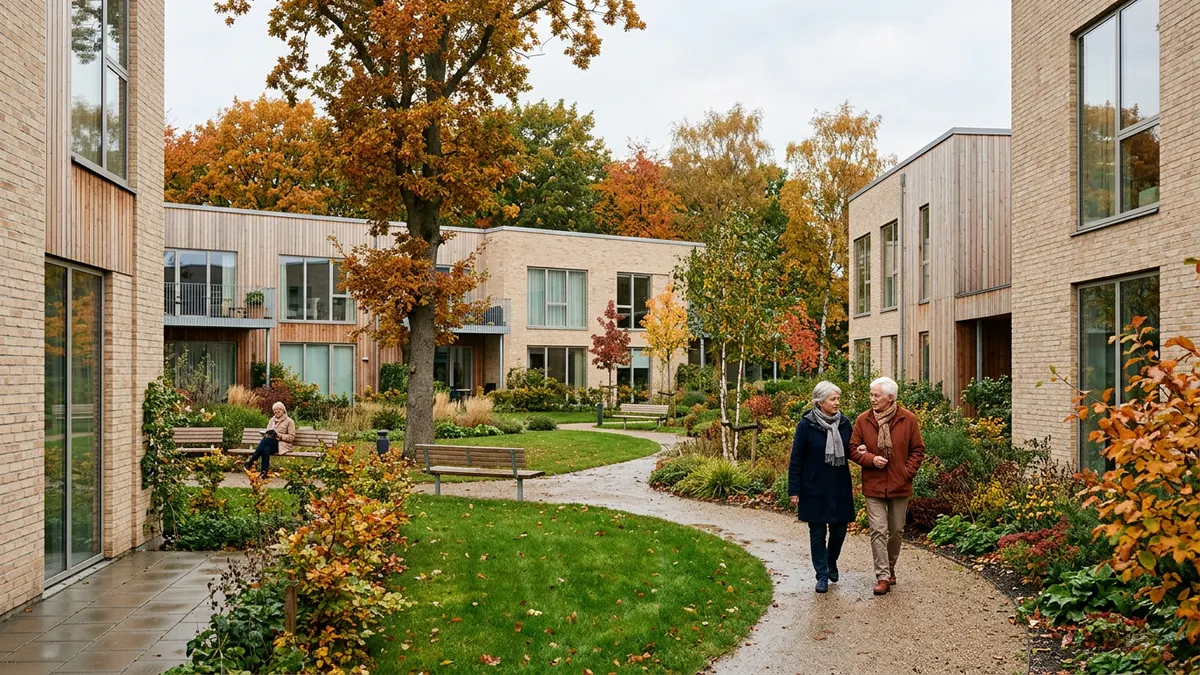
- Senior co-housing (seniorbofællesskaber): Homes built around common areas (community houses, workshops, vegetable gardens). The focus here is on the social aspect and combating loneliness. This type often requires more active administration but offers extremely loyal tenants and very low turnover.
- Assisted living/Service housing: Homes with associated services such as cleaning, meal plans, or access to healthcare staff. This is close to a friplejehjem (private nursing home) but typically operates on market terms.
| Housing Type | Primary Target Group | Operating Complexity | Typical Tenant Commitment |
|---|---|---|---|
| Senior-friendly flat | 60+, active | Low | Medium (5-10 years) |
| Co-housing | 65+, social | Medium | High (10-20 years) |
| Service housing | 75+, care needs | High | Medium |
Framework conditions and legislation in 2026
When investing in senior housing in Denmark, one must navigate a complex legal landscape. Lejeloven (the Rent Act) and Boligforholdsholdloven (the Housing Conditions Act) are the primary regulations defining the landlord-tenant relationship. In 2026, there remains a heavy focus on energy labelling and sustainability certifications like DGNB, which has become a requirement for many institutional investors and pension funds.
A significant factor is Planloven (the Planning Act) and local kommunale lokalplaner (municipal local plans). Many municipalities now have specific requirements that a certain percentage of new housing projects must be earmarked for seniors or co-housing to ensure a mixed resident composition. This can benefit the investor by providing access to byggeretter (building rights) that might otherwise be difficult to obtain.
It is important to note that rent-setting rules vary depending on whether the property is new-build (market rent applies to properties occupied after 31 December 1991) or older properties. For senior housing, new-builds or fully renovated properties are often most relevant, providing the investor with more flexibility in budgeting. When purchasing, investors must also account for the tinglysningsafgift (land registration fee).
Note: Legislation regarding tenancy law and property taxation may change. PropertyInvestments does not provide legal or tax advice, and we always recommend consulting specialised advisors and checking with relevant authorities such as Skattestyrelsen (the Danish Tax Agency) or Justitsministeriet (the Ministry of Justice).
Risk management in senior housing investment
While the foundation for senior housing is strong, no investment is without risk. As an investor, you should consider the following factors:
- Interest rates: Property prices and financing costs are directly affected by rates. Although we see stabilisation in 2026, stress scenarios should always be included in your financial model.
- Operating costs: Co-housing and properties with many shared facilities have higher operating costs. A precise operational plan is crucial to ensure the expected yield.
- Technological obsolescence: Seniors in 2026 are technologically savvy. Requirements for high-speed internet, smart-home security solutions, and energy-efficient systems are no longer "nice-to-have" but standard requirements.
- Economic sensitivity: While senior housing is often considered more resilient to downturns than commercial property or luxury flats, a decline in the general housing market can make it harder for seniors to sell their current homes, potentially delaying move-ins to new projects.
The investment process: From sourcing to final exit
When PropertyInvestments works with senior housing, we follow a structured process to ensure value creation. This begins with a thorough market analysis of the specific local area. We look not only at population figures but also at wealth levels, migration patterns, and the existing housing stock.
The next step is sourcing either building plots or existing properties with conversion potential. Here, having a strong network among landowners and municipal decision-makers is vital. Once a case is identified, due diligence is performed, covering legal, technical, and financial aspects.
The setup of the investment often involves choosing the right ownership structure and securing financing. This is followed by preparing the property, whether through new construction or optimising an existing portfolio. Finally, we manage the sale until it is finalised, whether the buyer is a private investor or an institutional player.
Why choose the senior segment now?
There are several reasons why 2026 is an ideal time to focus on this asset class. Firstly, there is political goodwill to promote housing forms that can relieve the public care system by keeping seniors self-sufficient and active for longer. Secondly, we have seen a maturation of the market, where operating models for senior co-housing have become more battle-tested.
Investing in senior housing also provides good portfolio diversification. Since the tenant mix is very stable and the ability to pay is generally high among Danish seniors, these properties act as a good hedge against inflation and market volatility. The long-term nature of the tenancies significantly reduces re-letting and refurbishment costs compared to youth housing.
Future sustainability requirements
ESG (Environmental, Social, and Governance) is no longer just a buzzword in 2026 but a core component of property investment. For senior housing, the Social element (the 'S' in ESG) is particularly pronounced. By creating frameworks that reduce loneliness and promote quality of life, you increase the property's value and appeal.
Environmentally (the 'E'), tenants expect low utility costs and a healthy indoor climate. Investors should therefore focus on long-lasting material choices and technical installations that minimise energy consumption. This not only ensures a greener profile but also protects the asset value against future tightening of environmental regulations.
Summary of market potential
The Danish market for senior housing is in a growth phase that will continue for many years. The combination of an affluent generation seeking new housing forms and a limited supply of dedicated senior housing creates an attractive platform for investment. By focusing on quality, location, and the right social facilities, investors can build robust portfolios with healthy returns.
However, it requires local knowledge and a deep understanding of the target group's needs. It is not just about building four walls, but about creating a home where people want to grow old. Successful senior housing investment therefore requires a balance between hard financial calculation and a human understanding of modern senior life.
Frequently asked questions
What is the typical return on investment for senior housing?
Returns vary depending on location and risk profile. Generally, returns are on par with or slightly above standard residential properties but with a lower risk profile due to higher tenant stability. Specific figures depend on market conditions in 2026.
Is senior housing only for those requiring care?
No, the majority of the market for senior housing investment targets active seniors (55-75+) who seek an easier daily life without house and garden maintenance but are still fully self-sufficient.
How do interest rates affect senior housing investments?
Interest rates affect both financing costs and investor yield requirements. However, as senior housing is seen as a safe haven, these projects can often secure attractive financing terms compared to more volatile property types.
What significance does ESG have for senior housing projects?
ESG is crucial. Investors focus particularly on social value creation (combating loneliness) and environmental sustainability, making the property more attractive to both tenants and future buyers (e.g., pension funds).
How PropertyInvestments can help
PropertyInvestments has been active in the Danish property market since 1985 and possesses the necessary experience to identify and execute the strongest cases within senior housing. We assist throughout the entire value chain – from initial sourcing and demographic analysis to technical optimisation and the final sale.
If you, as an investor, are considering entering the senior housing market, we are ready with concrete advice and access to relevant investment opportunities throughout Denmark. Contact us for a non-binding dialogue about your options.
Contact: info@propertyinvestments.dk | Phone: +45 31 16 31 00