Investing in building plots in Denmark requires a thorough understanding of planning legislation, soil conditions, and local market demand. The process spans from sourcing and screening undeveloped land to municipal processing and site development (byggemodning), through to the final sale or leasing of the completed property project, ensuring value creation through strategic development of raw land into infrastructure-ready parcels.
The Potential of Investing in Building Plots in Denmark
When discussing real estate investment, many focus on existing residential or commercial properties with ongoing cash flow. However, investing in building plots represents a different discipline where value is created through transformation. In September 2026, we see a market where demand for optimised building plots in growth areas such as Aarhus, Odense, and the Greater Copenhagen area remains intact, driven by a need for both modern housing and logistics facilities.
Buying land is not merely buying a parcel; it is buying an opportunity. The value of a plot is directly proportional to what can legally be constructed on it and how quickly this can be realised. Therefore, this type of investment requires a higher degree of specialist knowledge than traditional property investment. One must be able to read the terrain—both literally and legally.
In Denmark, land is a limited resource. With strict regulations for urban zones, rural zones, and summer house areas, the supply of shovel-ready plots is often lower than demand. This creates a foundation for potential price increases, but it also increases the risk if one does not perform due diligence correctly.
Identifying the Right Areas: SEO and GEO Strategy
Success in land investment depends heavily on location. However, in this context, location is not just about the current address, but about the area's future infrastructure.
Growth Zones in Jutland
In the Triangle Region (Vejle, Kolding, Fredericia), we see continued strong demand for building plots for logistics and business. The area's central location relative to the E45 motorway makes it a hub for distribution. When investing in land here, one must pay particular attention to transport corridors and the frameworks for business development in the kommuneplaner (municipal plans).
Aarhus and its surrounding areas, including growth towns like Skanderborg and Hinnerup, experience constant demand for residential building plots. Here, the challenge is often finding areas that can be converted from a landzone (rural zone) to a byzone (urban zone), which requires patience and good dialogue with municipal planners.
Development in Zealand and the Islands
Copenhagen is characterised by extremely few vacant plots, which has pushed investors further out into Zealand. Towns such as Roskilde, Køge, and Ringsted have become attractive for project developers, as improved infrastructure, including the future significance of the Fehmarn Belt connection, increases interest in both residential and commercial land in South Zealand and Lolland-Falster.
The Legal Framework: Local Plans and Municipal Plans
Before signing a purchase agreement for a plot, it is crucial to understand the planning constraints. In Denmark, the use of land is governed by the Planlov (Planning Act).
- Kommuneplan (Municipal Plan): This sets out the overall lines for the municipality's development. Here, one can see if an area is designated for future urban growth.
- Lokalplan (Local Plan): This is the most detailed document. A local plan determines exactly what may be built, how high it may be, the bebyggelsesprocent (plot ratio/building percentage), and often architectural requirements such as material choices.
If a plot is not covered by a local plan, or if one wishes to change the existing use, one must enter a process to have a new local plan prepared. This is a time-consuming process involving public hearings and political approval. When investing in building plots, this "planning risk" is one of the most important factors to include in your budget and timeline.
Due Diligence When Buying Land
One of the most frequent mistakes in land investment is underestimating the hidden costs beneath the surface. Thorough technical due diligence should always include:
Soil Investigations
Geotechnical borings are essential. If the soil is soft (e.g., silt or peat), it may require extra foundations or piling, which can cost millions and destroy the project's profitability. One should always secure a geotechnical report before the deal is final.
Environmental Conditions and Pollution
In Denmark, many plots are mapped as contaminated (knowledge level 1 or 2). Even if a plot is contaminated, it can still be built upon, but it often requires a §8-tilladelse (Section 8 permit) from the municipality and can lead to high costs for soil disposal. A pollution check with the region is a mandatory step.
Easements and Encumbrances
A review of the property's tingbog (land register) is necessary to identify easements. There may be old restrictions on use, rights of way, or utility lines running across the plot that prevent the planned construction.
| Factor | Impact on Investment | Recommended Action |
|---|---|---|
| Building Percentage | Determines how many sqm can be built | Check the local plan thoroughly |
| Soil Conditions | Can significantly increase foundation costs | Have geotechnical borings performed |
| Infrastructure | Access roads and utilities (power, water, sewage) | Investigate site development costs |
| Archaeology | Risk of construction halt if finds are made | Check museum records at the Agency for Culture and Palaces |
Economics and Financing of Raw Land
Financing land investment differs significantly from financing completed properties. Banks and mortgage institutions are generally more hesitant to finance raw land without an approved local plan or a concrete building permit.
Typically, an investor will need to provide a higher down payment—often between 30% and 50% of the purchase price. The interest rate on loans for land purchase is also often higher than for residential mortgages, as the risk to the lender is greater. It is therefore important to have a strong capital structure or access to private equity if operating in this market.
One should also budget for costs such as:
- Tinglysningsafgift (land registration fee).
- Advisors (lawyers, engineers, architects).
- Site development contributions (tilslutningsbidrag) to utility companies.
- Potential contributions to shared infrastructure in the area.
From Raw Land to Developed Plot
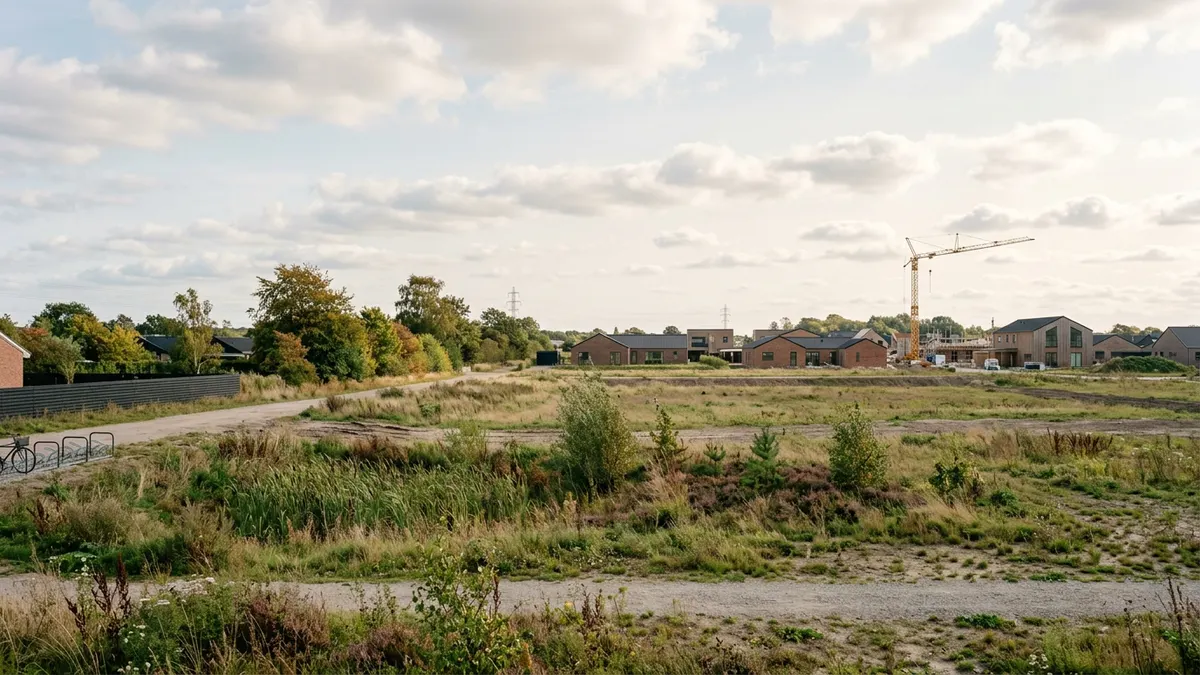
Once the land is acquired, the process of byggemodning (site development) begins. This is the phase where the land is transformed into a building-ready plot. This involves establishing roads, sewerage, water supply, electricity, and fibre broadband up to the boundary.
In many larger projects in cities like Roskilde or Vejle, site development occurs as a collaboration between private investors and utility companies. Here, it is important to manage the timing aspects, as delays in site development can postpone the start of construction and thus strain the project's liquidity.
An important aspect in 2026 is sustainability in the development phase. Requirements for surface water management (LAR solutions) have become stricter, and one must often establish retention basins or green wedges, which is both a regulatory requirement and a way to increase the value of the finished project.
Project Development and Exit Strategies
There are several ways to realise the gain from land investment:
- Buy and Hold (Land banking): Buying land in an area expected to increase in value over 10-20 years, without necessarily intending to build oneself. This requires great patience and low operating costs.
- Resale with Local Plan: Buying raw land, completing the political process of getting a local plan adopted, and then selling the land to a contractor or another investor at a significant profit.
- Total Development: Buying the plot, developing the site, constructing the building, and either selling the finished project as an investment case or keeping it for rental.
The choice of strategy depends on the investor's risk appetite and time horizon. In the current market, we see a trend towards investors seeking total development to maximise their returns, even if it entails greater operational risk.
Tax Considerations
Taxation on profits from the sale of building plots depends on whether one is considered to be trading in real estate professionally (næring) or if it is a passive investment. The rules are complex and can significantly impact the final after-tax return.
In commercial land investment, profits will typically be taxed as personal income or corporate income. There are also VAT (moms) considerations to be highly aware of. As a general rule, the sale of new buildings and building plots is subject to VAT in Denmark. One should always seek advice from a specialised accountant or tax lawyer to ensure correct handling of VAT and tax, as rules can be clarified by SKAT (Danish Tax Agency) or the courts at any time.
Risk Management in the Project
No investment is without risk, and land investment has its own unique pitfalls. In addition to technical risks regarding the land, there is market risk. The property market is cyclical, and since development projects often take 3-5 years from start to finish, the market situation may have changed drastically by the time the building is completed.
To minimise this risk, one should:
- Operate with realistic (and conservative) sale prices or rent levels.
- Build a buffer into the budget for unforeseen expenses (typically 10-15%).
- Have a Plan B, e.g., the possibility of renting out instead of selling.
- Stay updated on the latest requirements from the Building Regulations (BR) and EU taxonomy for sustainable construction.
Frequently asked questions
What is a bebyggelsesprocent (building percentage)?
The building percentage indicates how many square metres of floor area you may build relative to the total size of the plot. If a plot is 1,000 sqm and the building percentage is 30%, you may build 300 sqm. The rules for calculation are found in the Danish Building Regulations.
Can you build on agricultural land?
Generally, no. Agricultural land is located in a landzone (rural zone) and is protected. To be able to build, the land must be transferred to a byzone (urban zone) via a local plan and a municipal plan supplement, which is an extensive political process.
How long does a local plan process take?
A local plan process typically takes between 9 and 18 months from the initial meetings with the municipality to final approval, provided there are no major objections during the hearing phase or environmental obstacles.
Do you have to pay VAT (moms) on building plots?
Yes, the sale of building plots is generally subject to VAT in Denmark under the rules of the VAT Act. However, there are certain exceptions and grey areas, particularly regarding existing buildings for demolition, which is why legal assistance is recommended.
How PropertyInvestments can help
Since 1985, PropertyInvestments has assisted Danish and international investors in navigating the Danish property market. We actively source building plots and development projects across the country, from Copenhagen to the major growth cities in Jutland. We help prepare properties for sale, conduct initial screenings of local plans, and ensure that the process from land to finished project proceeds professionally.
If you are an investor seeking new opportunities in land investment, or if you have a property that needs to be developed and sold, you are welcome to contact us at info@propertyinvestments.dk or telephone +45 31 16 31 00 for a professional discussion of your project.