ESG properties have by 2026 become the foundation for value creation in the Danish real estate sector, as environmental, social, and governance criteria dictate access to both capital and tenants. Implementing sustainable measures reduces operating costs, ensures compliance with EU legislation, and minimises the risk of value loss in portfolios across Denmark.
The evolution of ESG properties in the Danish market
The concept of ESG – Environmental, Social, and Governance – has undergone a transformation from being a voluntary buzzword to an absolute necessity for professional investors in Denmark. In September 2026, we see a market where the divide between properties that meet modern standards and those lagging behind has become significantly clearer. For investors in cities such as Copenhagen, Aarhus, and Odense, it is no longer a question of if one should implement ESG, but how to do it most effectively.
Historically, the focus has primarily been on economic key figures. Yields, vacancy rates, and operating expenses have been the governing parameters. However, with the introduction of stricter EU directives, including the Corporate Sustainability Reporting Directive (CSRD) and the Taxonomy Regulation, environmental and social aspects are now directly linked to financial performance. A property without a clear ESG profile today risks becoming what the industry calls a "stranded asset" – an asset type that loses its value because it can no longer meet future requirements or be financed on reasonable terms.
In Denmark, we have a long tradition of energy efficiency, but ESG extends far beyond simply changing windows or insulating the attic. It involves a total Life Cycle Assessment (LCA), the building's impact on the local environment, and the way the property is managed in interaction with the tenants.
Environmental sustainability: More than just energy labels
When we talk about ESG properties, the environmental aspect (E) is often the most visible and measurable. It covers everything from energy consumption and CO2 footprint to water usage and waste management. In the major Danish growth cities, there are now high demands for the documentation of this data.
Energy efficiency and CO2 reduction
The core of the environmental effort is the reduction of greenhouse gas emissions. For existing properties in cities like Aalborg or Esbjerg, this often involves a thorough modernisation of technical installations. Optimising heating systems, implementing CTS-anlæg (Central Tilstandskontrol og Styring (Building Management Systems)), and transitioning to renewable energy sources such as heat pumps or fjernvarme (district heating) based on green energy are standard procedures.
Investors should, however, be aware that requirements are continuously tightened. What was considered a good energy class five years ago may be insufficient today. It is therefore crucial to consult the Bygningsreglementet (Building Regulations) and relevant authorities such as Energistyrelsen (Danish Energy Agency) to ensure compliance with the latest standards.
Circular economy and material choice
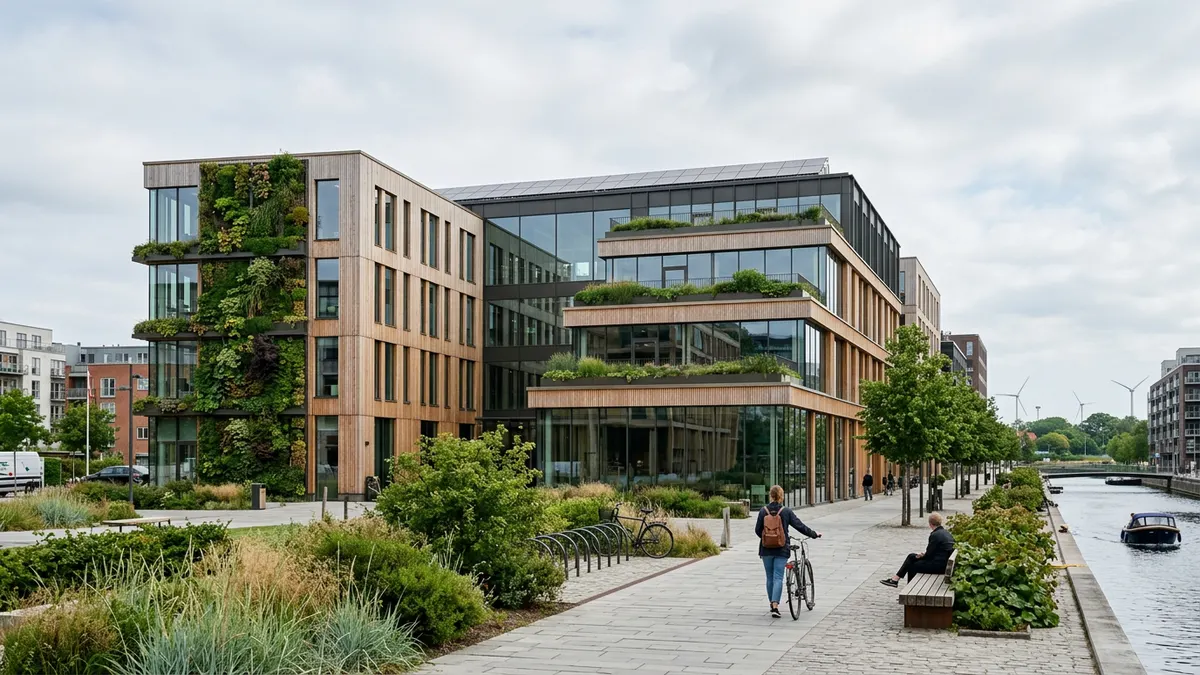
In connection with renovation or new construction, the choice of materials has become a central point. The use of recycled materials or materials with low "embodied carbon" helps improve the property's overall ESG score. This is particularly relevant in urban development areas where efforts are made to preserve existing structures rather than demolishing and building anew, saving vast amounts of resources.
The social dimension: People at the centre
The social aspect (S) of ESG is often overlooked, but it is just as important for the property's long-term value. In a real estate context, this involves well-being, safety, and inclusion.
- Indoor climate and health: Tenants in modern office properties expect a healthy working environment with good ventilation, natural light, and acoustic regulation. Properties that prioritise this often experience lower tenant turnover.
- Accessibility and infrastructure: A property's location relative to public transport and its accessibility for people with disabilities are central social parameters. In cities like Copenhagen and Aarhus, great emphasis is also placed on facilities for cyclists.
- The local community: How does the property contribute to its neighbourhood? Are there public spaces, green areas, or functions that create life at street level? A property that integrates positively into the local area will often be more resilient to market fluctuations.
Governance: Responsible management and transparency
Governance (G) is about how the company or property portfolio is managed. It involves proper decision-making processes, ethics, and, not least, data ethics. For investors in ESG properties, this means there must be full transparency in reporting.
In Denmark, we see an increased demand for certifications such as DGNB, BREEAM, or LEED. These systems serve as proof that the property is managed and built to the highest standards. It is also about managing suppliers and ensuring that no unethical practices occur throughout the entire value chain – from construction to daily operation.
Economic incentives and financing of ESG properties
One of the strongest drivers for sustainability in the real estate industry is access to capital. Danish mortgage institutions and banks have increasingly differentiated their lending products, so that properties with a strong ESG profile can obtain more attractive financing terms, often called "green loans."
| Parameter | Traditional Property | ESG-optimised Property |
|---|---|---|
| Financing costs | Standard market rate | Potential for green discounts |
| Rental level | Market rent | Often a 5-10% premium for certification |
| Operating costs | Unpredictable due to energy prices | Lower and more stable |
| Depreciation | High risk of technical obsolescence | Low risk; future-proofed |
| Investor demand | Declining for older segments | Very high from institutional investors |
Note: The above are general market trends as of 2026. Contact your bank or financial advisor for specific terms.
Legislation and framework conditions in Denmark
It is important to emphasise that the rules for ESG and property management are in constant development. Danish legislation closely follows the EU Taxonomy, which defines exactly what can be called a sustainable investment. For investors, this means being very precise with documentation.
Justitsministeriet (The Ministry of Justice) and Erhvervsstyrelsen (The Danish Business Authority) administer the overall frameworks for property trade and corporate governance in Denmark, while Planloven (The Planning Act) and Bygningsreglementet (Building Regulations - BR18 and subsequent updates) set the physical frameworks. It is always recommended to seek legal and technical assistance from specialists to ensure that an investment meets both current and upcoming requirements. PropertyInvestments does not provide legal or tax advice, but we observe that investors who ignore these requirements face greater challenges upon resale.
Challenges in implementing ESG
Although the benefits are many, the journey towards a complete ESG profile is not without obstacles. One of the biggest challenges in the current market is access to data. To report correctly, the owner must have access to tenants' consumption data, which requires good relationships and the right technical solutions.
Additionally, there are the financial costs of the optimisation itself. It requires capital to upgrade a property from energy label D to A. However, we often see that the long-term increase in value and risk elimination more than outweigh the initial investments. In cities such as Roskilde, Køge, and Herning, we see a trend where even smaller portfolios are now starting to integrate systematic ESG screenings when purchasing new assets.
Future perspectives for the Danish property market
Looking towards the end of the 2020s, the term "ESG properties" will likely merge with the term "prime properties." That is to say, a property cannot be considered a first-class investment if it is not sustainable. We also see increased digitisation, where artificial intelligence is used to optimise energy consumption in real-time, further strengthening the E-component of ESG.
For the private investor, this means the due diligence process has become more extensive. One must not only look at lease agreements and maintenance plans but also at climate risk assessments (e.g., risk of flooding during cloudbursts) and the building's social profile.
Summary of the value chain
When an investor wishes to place capital in the Danish market, it is essential to understand the entire value chain in an ESG context:
- Sourcing: Identification of properties with optimisation potential.
- Setup: Strategic planning of sustainability measures.
- Operation: Ongoing monitoring and reporting of ESG data.
- Sale: Documentation of the created value and green profile to the next buyer.
Denmark is in a unique position because we already have a high degree of digitisation and a district heating structure that makes the green transition easier than in many other countries. This makes the Danish market for ESG properties particularly attractive for foreign investors seeking stability and transparency.
Frequently asked questions
What do ESG properties mean in practice?
It refers to properties where documented consideration has been given to environmental impact (E), social conditions for users and neighbours (S), and responsible and transparent governance (G). This often results in lower operating costs and higher tenant well-being.
Is it mandatory to ESG-optimise my properties?
For large companies, there are requirements for sustainability reporting via EU directives (CSRD). For smaller investors, it is not necessarily a direct legal requirement yet, but market demands from banks and buyers make it necessary in practice to preserve the property's value.
How does ESG affect the return on my investment?
Although initial investments may be higher, ESG optimisation often leads to lower vacancy rates, higher rental income, and better financing terms. Overall, it protects against a "value-trap," where a property becomes unsellable due to poor energy standards.
Which certification is best in Denmark?
DGNB (Deutsche Gesellschaft für Nachhaltiges Bauen) is the most widespread standard in Denmark for certifying sustainable construction, as it is adapted to Danish conditions and building regulations. Other recognised standards include BREEAM and LEED.
How PropertyInvestments can help
PropertyInvestments has been active in the Danish property market since 1985. We have followed the development from the first energy requirements to today's complex ESG landscape. We assist our clients in identifying investment properties with a strong foundation or a clear optimisation potential.
Our role is to source the right assets, assist with the setup of the investment structure, and prepare the property for a future sale where the ESG documentation is in order. We facilitate contact between buyers and sellers and ensure that the process is completed with professional depth and knowledge of the local market throughout Denmark.
If you are an investor and wish to hear more about the opportunities within ESG properties, you are welcome to contact us for a specific dialogue about your needs.
Contact information: PropertyInvestments.dk Email: info@propertyinvestments.dk Telephone: +45 31 16 31 00