As a starting point, the leasing and sale of real estate in Denmark are exempt from VAT, but investors can achieve significant financial advantages through voluntary VAT registration. By opting for VAT on commercial properties, the landlord gains the right to deduct VAT on construction, operations, and maintenance, provided that the tenant conducts VAT-liable business activities on the premises.
Basic rules for VAT on commercial properties
When navigating the Danish property market, understanding the VAT rules is crucial for the total return on investment. In Denmark, the general rule in the VAT Act is that the leasing and sale of real estate are VAT-exempt. This differs significantly from many other goods and services where VAT is mandatory. However, for professional investors in cities like Aarhus, Copenhagen, and Odense, this exemption is often a disadvantage rather than a benefit.
The exemption means that as an owner, you do not have the right to deduct input VAT on the costs associated with the property. This applies to everything from tradesmen's invoices and administration fees to major renovation projects. Therefore, legislators have introduced the possibility of voluntary VAT registration, which is the foundation for most commercial property investments today.
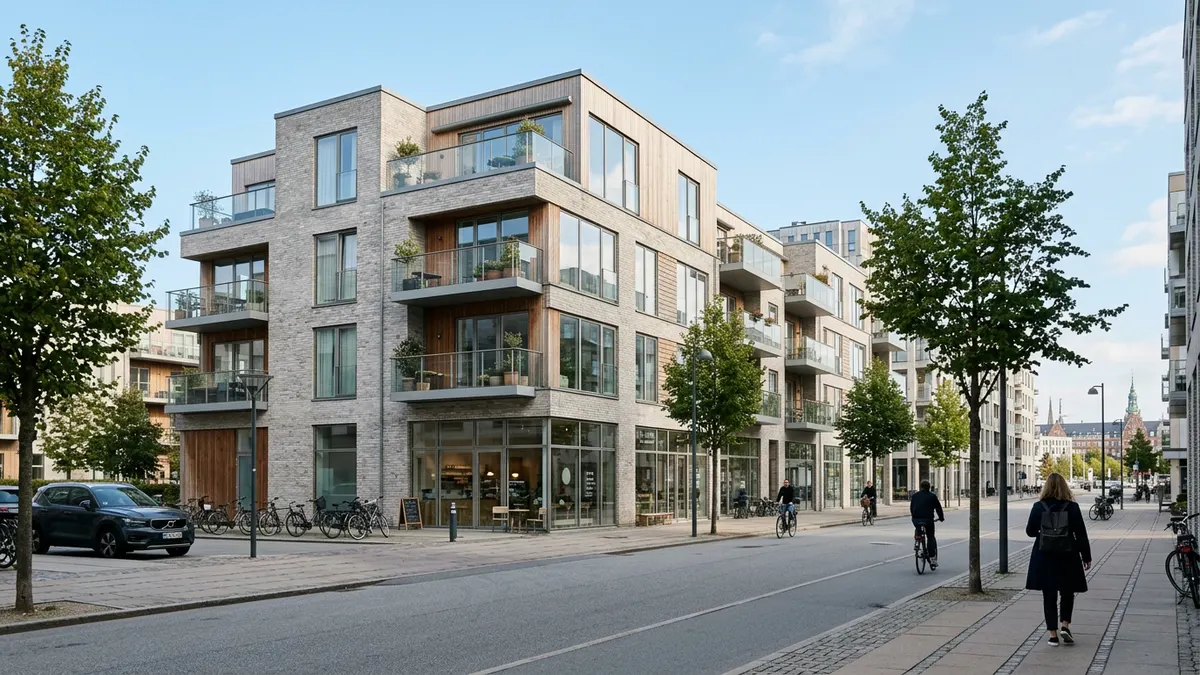
It is important to note that VAT on commercial property is only relevant for areas used for business purposes. Residential leasing is always VAT-exempt, and one can never be voluntarily VAT-registered for residential letting. This creates an important distinction for investors working with mixed-use properties in, for example, Aalborg or Esbjerg, where the ground floor may house retail (VAT-liable) while the upper floors are apartments (VAT-exempt).
Voluntary VAT registration: A strategic decision
The decision to apply for voluntary VAT registration with Skattestyrelsen (the Danish Tax Agency) should always be based on a concrete calculation of the property's operating economy. When a property is covered by a voluntary registration, 25% VAT must be added to the rent. In return, the owner gains a full right of deduction for VAT on all operating costs and investments linked to the relevant commercial areas.
To be voluntarily registered, a number of conditions must be met:
- The tenant must use the premises for VAT-liable purposes (business).
- The registration must cover the entire lease (one cannot VAT-register half an office).
- A lease agreement must exist, stating that the lease is subject to VAT.
In practice, this means that if you lease a warehouse in the Triangle Region to a logistics company, you will typically choose voluntary registration. Since the logistics company is VAT-registered itself, they can recover the VAT on the rent, making it cost-neutral for them. For you as the owner, however, it means you can get 25% back on your roof maintenance or paving of outdoor areas.
Why choose voluntary registration?
The primary motivation is liquidity and return. For major renovations or new builds of commercial properties in growth zones like Køge or Roskilde, VAT represents a huge item. Without VAT registration, the VAT on building materials and contracting services would become a final cost, increasing the investment requirement by 25%. By being VAT-registered, this 25% is refunded by the state, significantly improving the business case.
However, there is a commitment. A voluntary registration cannot simply be terminated from one day to the next without consequences. There are rules regarding adjustment periods, which we will review later in the article, meaning you commit to a certain VAT status over a number of years (typically 10 years for real estate).
VAT on the purchase and sale of commercial properties
The sale of real estate is, as a rule, VAT-exempt. However, there is a significant exception that came into force in 2011: the sale of new buildings and building plots is VAT-liable. The definition of a "new building" in this context is a building completed after 1 January 2011, or where significant renovations have been carried out.
When an investor buys an older commercial property in, for example, Randers or Herning for the purpose of leasing, a decision must be made as to whether the transfer takes place as part of a transfer of going concern (virksomhedsoverdragelse). If the buyer continues the VAT-liable leasing activity, the transaction can often be completed without VAT settlement, provided the buyer takes over the VAT obligations (succession).
Table: Overview of VAT liability for different property types
| Property type | VAT liability on sale | Voluntary registration possible? | Deduction right for operations |
|---|---|---|---|
| New buildings (built after 2011) | Yes (25%) | Yes | Yes |
| Used commercial properties | No | Yes | Yes (if registered) |
| Residential properties | No | No | No |
| Building plots | Yes | N/A | Yes (during development) |
| Mixed-use properties | Partial (only new-build part) | Only commercial part | Pro rata (distributed) |
It is always recommended to consult a tax advisor or accountant for transactions, as incorrect handling of VAT on commercial property can lead to large back-tax bills and fines from Skattestyrelsen (the Danish Tax Agency).
The adjustment obligation: The 10-year commitment
One of the most complex aspects of Danish VAT law regarding real estate is the adjustment obligation (reguleringsforpligtelsen). When you make an investment in a property (new construction or significant renovation) and deduct the VAT, a 10-year adjustment period arises. The state's logic is that if you have received a VAT refund in exchange for promising to use the property for VAT-liable leasing, you must continue to do so for 10 years.
If the property changes status within those 10 years – for example, if a VAT-liable shop in Hillerød is converted into a VAT-exempt medical clinic or residence – a proportionate share of the previously deducted VAT must be paid back to Skattestyrelsen (the Danish Tax Agency). This is known as a repayment obligation or adjustment.
Example of adjustment
Assume an investor renovates an office building for DKK 1,000,000 plus VAT (DKK 250,000). The investor is voluntarily VAT-registered and receives the DKK 250,000 back from the state. After 4 years, the investor chooses to lease the building to a VAT-exempt organisation (e.g., a school or an association). Since 4 out of the 10 years have passed, 6 years of the adjustment period remain. The investor must therefore pay 6/10 of the DKK 250,000 back to the state, corresponding to DKK 150,000.
This risk must always be factored into the exit strategy or when changing the tenant mix. When selling the property, the adjustment obligation can often be transferred to the buyer if the buyer is VAT-registered, but this requires precise documentation and correct clauses in the purchase agreement.
Partial deduction rights in mixed-use properties
Many investment properties in Danish provincial towns like Viborg, Slagelse, or Silkeborg are so-called mixed-use properties. Here, you typically find commercial units on the ground floor and residences on the upper floors. In these cases, the VAT must be apportioned.
Costs that can be directly attributed to the commercial part (e.g., a new shop window) allow for full deduction if you are voluntarily registered. Costs for the residential part allow no deduction. Common costs – such as roof repairs, facade renovation, or stair cleaning – must be distributed pro rata, typically based on the square footage ratio between commercial and residential. If the commercial part makes up 40% of the total area, you can deduct 40% of the VAT on common expenses.
This division requires strict bookkeeping and a clear overview of the property's use. Skattestyrelsen (the Danish Tax Agency) regularly conducts audits to ensure that the allocation keys are correct and that no deductions are taken for areas that are rightfully used for housing.
Special rules for building plots
Since 2011, the sale of building plots (byggegrunde) has been VAT-liable. This has great significance for developers sourcing land for projects in growth areas around Aarhus or in the new districts of Copenhagen's South Harbour. When you buy a building plot from a VAT-registered seller (e.g., a municipality or a development company), 25% VAT must be paid on top of the price.
If the purpose is to construct commercial properties for VAT-liable leasing, this VAT can be recovered. However, if you plan to build private homes for sale or lease, the VAT on the land becomes a final cost that must be factored into the project's profitability. It is therefore crucial to know the land's VAT status before making a binding offer.
Administration and compliance
Being voluntarily VAT-registered requires ongoing administration. In addition to collecting VAT on the rent and reporting it to Skattestyrelsen (the Danish Tax Agency), you must ensure that your tenants actually operate a VAT-liable business. If a tenant changes status (e.g., moves from selling clothes to operating a physiotherapy clinic, which is VAT-exempt), the landlord loses the right to collect VAT for that lease – and thus also the right of deduction for the related costs.
It is recommended to incorporate clauses in commercial lease agreements (erhvervslejekontrakter) that oblige the tenant to disclose changes in their VAT status and potentially grant the landlord the right to compensation if a change results in VAT losses or adjustment requirements for the landlord.
Checklist for investors:
- Is the property voluntarily VAT-registered today?
- Are there remaining VAT adjustment obligations (reguleringsforpligtelser) on the property?
- Do current tenants meet the conditions for VAT-liable leasing?
- Are the lease agreements legally up-to-date regarding VAT?
- Upon purchase: Is this a transfer of going concern (virksomhedsoverdragelse) with succession?
The Danish property market is characterised by stability and transparency, but VAT rules are one of the areas where complexity is highest. Whether investing in warehouses in Vejle or office facilities in Frederiksberg, the VAT structuring is fundamental to the property's valuation (yield).
Future trends and legislation
Although the rules for VAT on commercial property have remained relatively stable in recent years, interpretations are ongoing through case law and rulings from the Landsskatteret (National Tax Tribunal). In particular, the boundaries for when a renovation is so extensive that a building is considered "new" in a VAT sense is a moving target. Likewise, there is an increased focus on sustainability renovations (ESG) and how VAT deductions are handled for energy optimisation of older property stock.
As an investor, it is important to stay informed via official channels like Skattestyrelsen (the Danish Tax Agency) or seek professional assistance from advisors specialising in property tax rules. PropertyInvestments follows these developments closely to ensure that the properties we source and prepare for sale are always optimised in relation to current legislation.
Summary of VAT rules
Managing VAT on commercial property is not merely a technical exercise but a strategic tool. Correct structuring can mean the difference between a profitable investment and a case with unforeseen costs. By using voluntary VAT registration, you can secure deductions for major expense items, but you must be aware of the requirements and commitments that follow, including the 10-year adjustment period.
Remember that this article is of a general nature and does not constitute legal or tax advice. Any investment decision should take place in consultation with relevant professionals who can assess the specific case in relation to the current legislation at the time of the transaction.
Frequently asked questions
Can you get a VAT deduction for renovating a residential property?
No, the leasing of residences is VAT-exempt in Denmark, and there is no possibility for voluntary VAT registration for residential areas. Therefore, there is no right of deduction for VAT on costs related to the residential part of a property.
What happens to the VAT if my commercial tenant goes bankrupt?
If a tenant goes bankrupt, the VAT-liable activity in the lease stops. You must stop calculating VAT on the rent (as there is no rental income), but you generally retain your voluntary registration for the lease with a view to finding a new VAT-liable tenant. However, one must be aware of the rules regarding vacancy periods and the adjustment obligation (reguleringsforpligtelse).
How long is the adjustment period for repairs?
For ordinary maintenance and repairs, there is no adjustment period. The 10-year adjustment period applies only to "investment goods" (investeringsgoder), which means new construction and renovations where the VAT on the expense exceeds DKK 100,000 in a single financial year.
Do you have to pay VAT on the sale price of an old warehouse?
Generally, no. The sale of "used" buildings (completed before 2011 and without significant renovations) is VAT-exempt. However, one must be aware of whether there is an adjustment obligation (reguleringsforpligtelse) that must be transferred to the buyer or settled with Skattestyrelsen (the Danish Tax Agency).
How PropertyInvestments can help
Since 1985, PropertyInvestments has helped Danish and international investors find and optimise investment properties across Denmark. We understand the importance of correct VAT handling in both sourcing and preparing properties for sale. We assist in identifying properties with optimisation potential and ensure that all practicalities are in place before a property is presented to potential buyers. Contact us at info@propertyinvestments.dk or +45 31 16 31 00 for a dialogue about your investment opportunities in the Danish market.