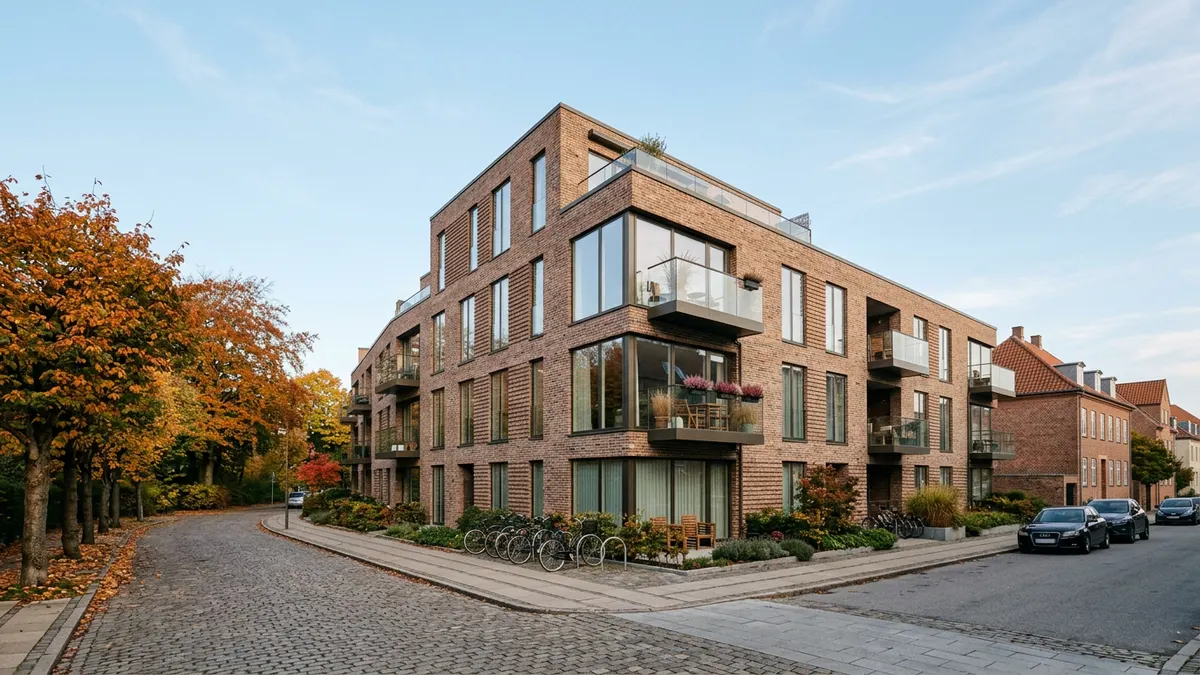
The virksomhedsskatteordningen (business tax scheme (VSO)) is a tax framework that allows private investors to tax profits from property rentals at a provisional corporate rate rather than personal income tax. By applying the business tax scheme to properties, investors can achieve full deductibility for interest expenses and reinvest profits more efficiently into new projects.
What is the business tax scheme for properties?
The virksomhedsskatteordningen (VSO) is a voluntary scheme for sole traders, including individuals investing in real estate for rental purposes. The purpose of the scheme is to provide personally owned businesses with tax conditions similar to those applicable to an anpartsselskab (private limited company (ApS)) and aktieselskab (public limited company (A/S)). In a Danish context, this is particularly relevant for investors in cities like Copenhagen, Aarhus, Odense, and Aalborg, where property prices and thus financing needs are often significant.
When using the business tax scheme for properties, private finances are separated from the business's finances for tax purposes. This means you can choose to leave profits within the business against payment of a provisional business tax, which in 2026 corresponds to the corporate tax rate. This provides a liquidity advantage, as you can save funds for maintenance of the property portfolio or for the down payment on the next investment property without first paying topskat (top-bracket tax) on the entire year's profit.
It is important to emphasise that VSO is a complex scheme that requires meticulous bookkeeping. All movements between private finances and business finances must be recorded, and a tax-compliant annual report must be prepared that meets the requirements of the Business Tax Act. PropertyInvestments always recommends consulting an authorised accountant or tax advisor before opting into the scheme.
Advantages of the business tax scheme for properties
For the serious investor in Danish rental properties, there are several significant advantages to using VSO rather than the standard kapitalafkastordning (capital return scheme) or taxation under the Personal Tax Act.
1. Full deduction for interest expenses
One of the biggest motivations for choosing the business tax scheme for properties is the treatment of interest expenses. In the private sphere, interest expenses have a limited deduction value (typically around 25-33% depending on the residential municipality and other deductions). Within VSO, interest expenses are deducted from the business profit before tax. This means the deduction value corresponds to the taxation of personal income (up to approx. 52-56% including top-bracket tax), which significantly reduces the effective financing cost.
2. Retention of profits
If an investor owns a property in, for example, the Triangle Region or Esbjerg that generates a significant annual profit, this profit would normally be added to the investor's other salary income. With VSO, one can choose to let the profit remain in the scheme against payment of the low provisional tax. This creates a "tax credit" that can be used to consolidate the business or pay down debt faster.
3. Flexibility in income smoothing
The property market can vary, and maintenance costs can hit unevenly. VSO allows for the smoothing of personal income over several years. In years with large renovation expenses, one can withdraw from the saved profit, while in years with high rental income, the money can be left in the scheme. This can help the investor stay below the top-bracket tax threshold.
Basic rules and requirements in VSO
To apply the business tax scheme to properties, a number of requirements must be met. Not all types of properties can be included in the scheme, and there are strict requirements for the separation of assets.
- Commercial activity: The rental of real estate is, as a rule, always considered a commercial business for tax purposes, unless it involves renting to relatives below market rent.
- Bookkeeping obligation: Accounts must be kept that meet the requirements of the Bookkeeping Act. This includes a clear division of which bank accounts belong to the business and which are private.
- Current account: All transfers between the owner and the business must be recorded. If the owner withdraws more money than there is profit for, a withdrawal occurs in the order of priority, which can have tax consequences.
- Mixed-use properties: If an investor owns a property where they live in part of it themselves (e.g., a 2-family house), only the rented part can be included in VSO. A precise allocation of expenses and value must be performed here.
Overview of taxation models
| Parameters | Personal Tax Act | Capital Return Scheme | Business Tax Scheme (VSO) |
|---|---|---|---|
| Interest deduction | Limited value (approx. 25-33%) | Limited value | Full deduction value in the business |
| Profit tax | Personal income tax (up to approx. 56%) | Personal income tax | Provisional corporate tax (approx. 22%) |
| Administration | Simple | Medium | High (requires accountant) |
| Savings | Not possible | Limited | Fully possible |
Interest and interest correction
One of the more technical aspects of the business tax scheme for properties is the rentekorrektion (interest correction). The interest correction is a mechanism that ensures the investor does not receive too large a tax advantage if private debt has been placed in the business, or if the business assets are financed with negative capital.
If a property with high leverage is transferred to VSO and the business capital becomes negative, an interest correction must be calculated. This correction moves part of the interest expenses from the business (where they have high deduction value) to the private sphere (where they have low deduction value). It is therefore essential to manage your kapitalafkastgrundlag (capital return base) when sourcing properties in growth areas like Roskilde, Køge, or Silkeborg, where high gearing is often used.
The capital return base and its significance
The kapitalafkastgrundlag (capital return base) is the heart of VSO. It is calculated at the start of the year and represents the book value of the business assets minus the debt.
- Positive capital return: If the capital return base is positive, a capital return is calculated, which is taxed as capital income instead of personal income. This is often an advantage, as the tax rate on capital income is typically lower than on top-bracket personal income.
- Negative base: If debt exceeds the value of the assets, the interest correction mentioned above is triggered.
For property investors acquiring properties for renovation (value-add projects), the capital return base can change significantly as improvements are capitalised on the property. This is where PropertyInvestments sees many investors optimise their portfolio by continuously reinvesting profits into the substance of the property.
Property investment in different regions with VSO
The choice of geographical focus has a major impact on how VSO works for you. In major cities like Copenhagen and Aarhus, the yield (percentage-wise) is often lower, but the potential for capital appreciation is higher. Here, VSO will primarily be used to maximise the interest deduction on the large loans required to buy centrally.
In the provinces, for example in cities like Randers, Viborg, or Slagelse, the ongoing operating yield is often higher. Here, the possibility of saving profits in the scheme at the low provisional tax rate becomes particularly attractive. The investor can accumulate capital faster for the purchase of the next property, accelerating the snowball effect in portfolio building.
Whether investing in residential rentals or commercial real estate, VSO provides a framework that makes it possible to act professionally even if you own the properties personally.
Challenges and pitfalls of VSO
Although the business tax scheme for properties offers many advantages, there are also risks to be aware of.
Mandatory withdrawals
If an investor needs to withdraw money from the scheme for private consumption, a fixed sequence in the tax law must be followed. One withdraws first from the year's profit, then from saved profits from previous years, and finally from the deposit account. If one withdraws from saved profits, the residual tax (the difference between the provisional tax and personal income tax) is triggered. This can result in an unexpected tax bill if liquidity has not been planned.
Administration and costs
It is rarely advisable to handle VSO yourself. The requirements for bookkeeping and the preparation of accounts mean that you typically have to pay an accountant between 10,000 and 25,000 DKK annually per set of accounts, depending on complexity. These costs must be offset against the tax savings. As a rule of thumb, it is often said that a portfolio must have a certain volume before VSO becomes profitable.
Transfer of properties
When a property is sold, the profit (ejendomsavance (property gain)) also becomes part of the business profit in VSO. Here, one can again choose to let the gain remain in the scheme and reinvest it in a new property, thereby deferring taxation. However, this requires precise timing and advice to avoid hitting the rules on property gain taxation disadvantageously.
Comparison: VSO vs. Holding/ApS
Many investors consider whether they should buy properties via VSO or through an anpartsselskab (ApS).
- VSO: Provides better interest deductions for personal debt and is more flexible regarding moving money in and out of the business section. However, it is personally owned, meaning the investor is personally liable for the debt.
- Company (ApS): Provides limited liability, which offers significant security. Conversely, the interest deduction is locked within the company, and it can be more expensive to get money out for private use due to dividend tax.
The choice often depends on the investor's other income circumstances and risk appetite. In high-risk areas, a company may be preferable, while VSO is often strong for the long-term investor seeking maximum return on their liquidity.
Important considerations in September 2026
The market for property investment in Denmark has changed continuously. In September 2026, it is important to stay updated on the latest rates for interest correction and capital returns set by Skattestyrelsen (the Danish Tax Agency). Likewise, one should be aware of any political initiatives regarding mark-to-market taxation or changes in the Rent Act that could affect property values and thus the capital return base.
Property investment is a long-term discipline. The use of the business tax scheme for properties supports this long-term approach by providing the investor with the tools to withstand economic fluctuations and optimise tax payments over decades.
Final remarks
The business tax scheme is one of the most powerful tools for the Danish property investor. It bridges the gap between private investment and professional corporate structures. By ensuring full interest deductions and the possibility of tax-favoured retention of profits, VSO creates the foundation for growth.
However, the complexity must never be underestimated. Every decision to buy, sell, or renovate a property within the scheme has tax implications that extend years into the future. Therefore, the combination of skilled property sourcing and strong tax-technical advice is the path to success in the Danish property market.
Note: This article is for informational purposes only and does not constitute legal or tax advice. Rules regarding VSO and property taxation can be changed by the Folketing (Danish Parliament). Always contact a qualified accountant or tax lawyer, as well as relevant authorities like Skattestyrelsen, for specific advice on your situation.
Frequently asked questions
Can I use VSO for a property I live in myself?
No, the business tax scheme is reserved for commercial business. If you live in the property, it is considered private use. In the case of a mixed-use property, only the part used for rental can be included in the scheme.
What does it cost to have VSO?
The primary costs are for an accountant, as the accounts must meet specific requirements in the Business Tax Act. Typically, the expense lies between 10,000 and 25,000 DKK annually, but it depends on the size of the portfolio and the number of entries.
Can I switch from VSO to ordinary taxation?
Yes, you can step out of the scheme, but it often requires settling the saved profits, which leads to residual taxation. This is a process that should be planned carefully with an accountant to avoid liquidity challenges.
Is the interest deduction really better in VSO?
Yes, as a starting point, interest expenses in VSO have a higher deduction value because they are offset directly against the business profit before personal tax is calculated. This contrasts with private individuals' interest deductions, which are limited to the tax value of capital income.
How PropertyInvestments can help
Since 1985, PropertyInvestments has helped investors find and optimise investment properties throughout Denmark. We offer professional sourcing of properties that fit a strategy involving the business tax scheme, and we assist in preparing properties for operation or sale. We have an in-depth knowledge of the Danish market and can guide you through the process from the first viewing to the final sale. Contact us at info@propertyinvestments.dk or by phone at +45 31 16 31 00 for a non-binding dialogue about your opportunities as an investor.