Property project finance in Denmark is a complex process requiring a combination of equity, bank financing, and often mezzanine capital. It involves structuring capital for the construction or total renovation of residential and commercial properties, where repayment typically occurs through the sale of units or long-term refinancing upon completion.
Introduction to property project finance in the Danish market
When discussing property project finance in Denmark in 2026, we find ourselves in a market that demands high precision and extensive documentation. Project finance differs from standard realkreditfinansiering (mortgage credit financing) by focusing on a specific asset's future cash flows and value creation rather than the developer's existing portfolio alone. It is a discipline where risk is highest during the construction phase, but where potential returns likewise reflect this risk.
In the current economic landscape, we are seeing increased selectivity among traditional banks. Where high loan-to-value ratios were previously achievable, a more robust capital structure is now required. This has led to a professionalisation of the industry, where players in growth cities like Copenhagen, Aarhus, Odense, and Aalborg must navigate a complex web of regulatory requirements, sustainability certifications, and financial covenants.
This article reviews the fundamental elements of property project finance, from initial capital needs to the final exit strategy. We take a closer look at the various financing sources, the legal framework in Denmark, and the specific conditions applicable to both Danish and international investors.
Capital structure in Danish property development
Sound property project finance is built on a well-balanced capital structure. In Denmark, this is typically divided into three main layers, each with different risk profiles and return requirements.
Equity
Equity is the foundation. For most projects today, financing sources require the developer to inject between 20% and 35% of the total project cost. This serves as a buffer against potential budget overruns or price drops for the finished product. Equity is the first to be lost in adversity, but also the portion that receives the residual proceeds and thus the highest return.
Senior Debt
Senior debt is typically provided by banks or realkreditinstitutter (mortgage credit institutions). During the construction phase, this often takes the form of a byggekredit (construction loan), which is paid out continuously in line with the project's progress (the instalment model). The advantage of senior debt is the relatively low interest rate compared to other forms of capital, but the disadvantage is the strict security requirements, including a pant (charge/mortgage) on the property and often personal or parent company guarantees.
Mezzanine Financing (Junior Debt)
Mezzanine capital fills the gap between senior debt and equity. It is a more expensive form of financing, but it allows the developer to initiate larger projects with less tied-up equity. In Denmark, the market for mezzanine loans has grown significantly, especially in connection with larger residential projects in the Capital Region and surrounding areas.
| Financing Type | Typical Share | Risk | Return Requirement |
|---|---|---|---|
| Senior Debt | 50 - 65% | Low | Low (Interest + margin) |
| Mezzanine Capital | 10 - 20% | Medium | Medium/High |
| Equity | 20 - 35% | High | High (Residual proceeds) |
The importance of phases for property project finance
Financing needs and options change drastically during a property's lifecycle. The process is typically divided into three main phases, each requiring a different approach to property project finance.
1. Land and planning phase
This phase is the riskiest. It involves financing the purchase of the land and expenses for architects, engineers, and lokalplansarbejde (local planning work). Many banks are reluctant to finance raw land without an approved lokalplan (local development plan). Here, we often see investors using equity or specialised funds until the building permit is available.
2. Construction phase
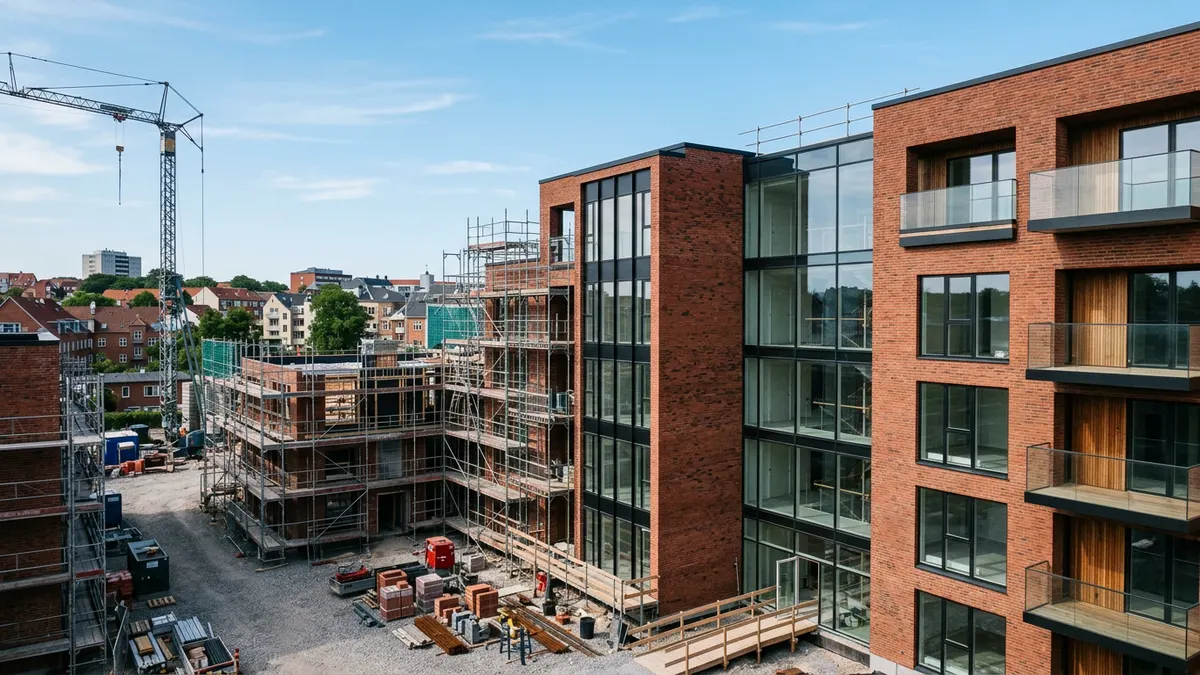
Once the building permit is secured and the main contract price is fixed, the construction loan is activated. Financing here is closely linked to project management. The bank will typically require an independent surveyor to approve individual acontobetalinger (progress payments) to the contractor. This ensures that no more is paid out than the value created on the construction site.
3. Operational or sales phase
When the property is finished and has received an ibrugtagningstilladelse (occupancy permit), the project finance must be replaced by permanent financing. If the property is to be kept as a rental, the construction loan is refinanced into a mortgage loan. If it involves apartments for sale, the debt is repaid continuously as individual units are transferred to buyers via a skøde (deed of conveyance).
Regional differences and market conditions in Denmark
Geography plays a decisive role in how property project finance is structured. Although Denmark is a small country, there is a big difference in bank appetite depending on location.
In Copenhagen and the surrounding area (including growth areas like Nordhavn, Sydhavn, and the new districts in Rødovre and Glostrup), market liquidity is high. It is easier to find investors, but land prices are correspondingly high, which squeezes the yield. Here, financing models are often very sophisticated, involving international private equity funds.
In Aarhus, especially around Aarhus Ø and the central urban development areas, we see a similar trend. The market is strong, but the requirement for architectural quality and sustainability (DGNB certification) is very pronounced, which must be incorporated into the financing budget.
In cities like Odense and Aalborg, we have seen massive development in recent years. Here, you can often achieve a higher yield than in Copenhagen, but banks may be more focused on long-term rental security. For projects in smaller provincial towns, a significantly higher equity share is often required, as the re-letting risk is assessed as higher.
Legislation and regulatory frameworks
When working with property project finance in Denmark, there are a number of legal aspects to be aware of. The Danish system is characterised by high transparency but also strict regulation.
- Planloven (The Planning Act): Establishes the framework for what can be built where. A change in the local plan can have a decisive impact on the property's value and thus the financing options.
- Lejeloven (The Rent Act): For investors building for rent, it is crucial to understand Danish rules for rent setting. Particularly the rules on fri fastsættelse af leje (unrestricted rent setting) in new builds (post-1991) are fundamental to calculating the property's return.
- Tinglysningsloven (The Land Registration Act): Secures rights over real estate. In project finance, correct registration of pantebreve (mortgage deeds) and servitutter (easements/covenants) is vital for the lender's security.
- Hvidvasklovgivningen (AML): Both Danish and international investors must go through extensive KYC (Know Your Customer) procedures with Danish financial institutions.
It is always recommended to seek professional legal assistance from solicitors specialising in real estate, as well as tax advice, to ensure the structure is optimised in accordance with current Danish law. One should consult SKAT (Danish Tax Agency) or relevant authorities for the latest rates and rules.
Risk management in project finance
Successful property project finance is largely about identifying and mitigating risks. The most common risks include:
- Contractor risk: The risk of the contractor going bankrupt or failing to deliver on time/at the agreed quality. This is often managed through bank guarantees (AB18 guarantees).
- Interest rate risk: As construction projects often run for 18-36 months, interest rate hikes can blow the budget. Interest rate swaps or caps can be used to hedge this risk.
- Exit risk: The risk that units cannot be sold or let at the budgeted prices. Banks often require a certain level of pre-letting or pre-sale before releasing large loan tranches.
- Regulatory risk: Delays in building permits or appeals against local plans can postpone the project and increase financing costs significantly.
Future trends: ESG and Digitalisation
In 2026, ESG (Environmental, Social, and Governance) is no longer an option but a requirement to obtain attractive property project finance. Banks increasingly offer "green loans" with lower interest rates for projects achieving high sustainability certifications like DGNB Gold or Platinum.
Investors must be able to document the property's CO2 footprint throughout its entire lifecycle. This affects not only construction costs but also the property's value at exit, as institutional investors like pension funds have strict requirements for the properties they purchase.
Digitalisation also plays a role. The use of BIM (Building Information Modelling) makes it possible to estimate costs and risks more accurately, giving lenders greater security and potentially better loan terms.
Summary of the financing process
The process for property project finance can be summarised in the following steps:
- Screening: Assessing project viability, location, and market potential.
- Budgeting: Preparing detailed cash-flow analyses, including soft costs (consultants) and hard costs (the construction itself).
- Capital Sourcing: Negotiating with banks and potential mezzanine partners.
- Due Diligence: Technical, legal, and financial review of the project.
- Execution: Continuous monitoring of the construction process and release of funds.
- Exit: Sale of the property or refinancing into long-term debt.
For international investors, it is worth noting that the Danish mortgage system is unique and provides access to some of the world's most stable and inexpensive financing sources for completed properties. This makes Denmark an attractive market for long-term real estate investments.
Frequently asked questions
What is typically required in equity for property project finance?
Typically, between 20% and 35% of the total project sum is required in equity. The requirement depends on the project's risk profile, the developer's experience, and the property's location. In growth cities like Copenhagen and Aarhus, requirements may occasionally be lower if strong pre-letting or pre-sale agreements are in place.
Can international investors obtain project finance in Danish banks?
Yes, international investors can obtain financing, but they will face extensive documentation requirements (KYC). Often, the bank will require a Danish project company (SPV) to be established and a local partner or advisor with knowledge of the Danish market to be attached to the project.
What significance does DGNB certification have for financing?
A DGNB certification (or equivalent like BREEAM or LEED) is now almost a prerequisite for obtaining the best loan terms. Many banks offer green construction loans with reduced margins for sustainable projects, as these are considered to have a lower risk of future value impairment.
What is the difference between a construction loan and a mortgage loan?
A byggekredit (construction loan) is a temporary, variable financing tool used during the construction process. You only pay interest on the amount drawn. A realkreditlån (mortgage loan) is long-term financing (up to 30 years) granted against a charge on the finished property. The mortgage loan can only be paid out once the property is completed and valued.
How PropertyInvestments can help
PropertyInvestments has specialised since 1985 in bridging the gap between investors and the Danish property market. We assist in sourcing the right projects, setting up the optimal structure, and preparing the property for the final sale. Our experience ensures professional management of the entire value chain, from initial analyses to contact with financial partners. For serious investors seeking specific opportunities within property project finance in Denmark, we can be contacted for an in-depth dialogue on current market opportunities and strategic advice.