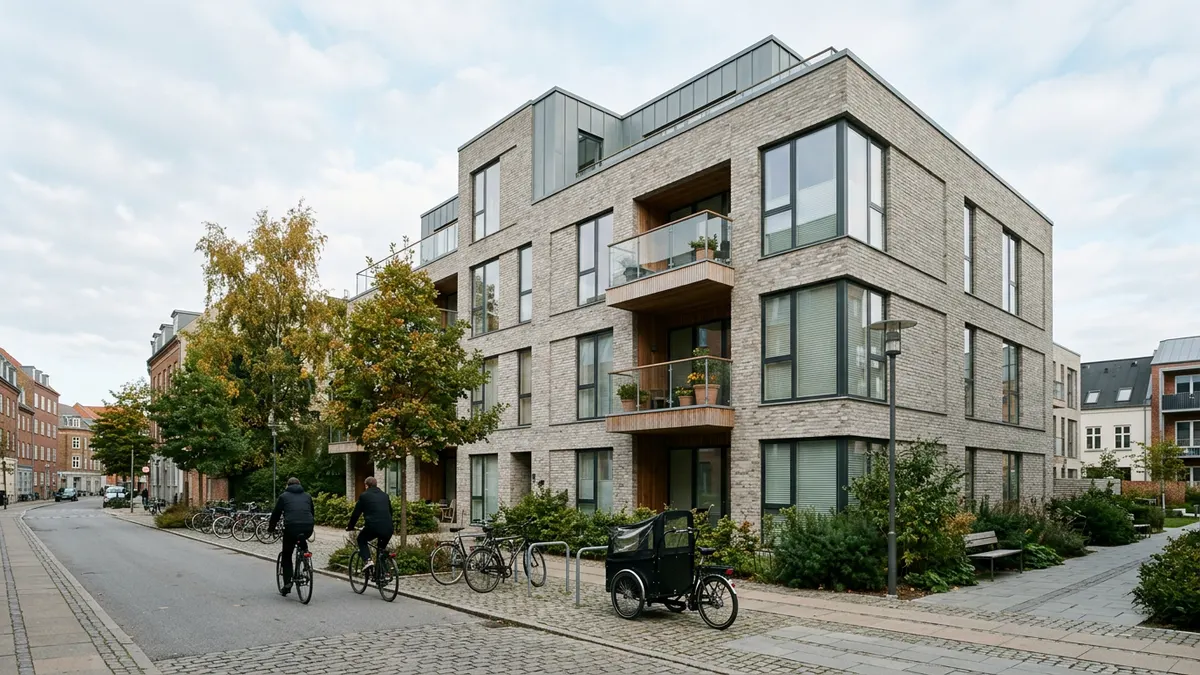
Property investment for pension purposes in Denmark can be conducted through various structures, depending on whether the funds are held in a private pension scheme, a holding company, or via the Virksomhedsordningen (VSO) (Business Tax Scheme). Although the direct purchase of bricks and mortar using private pension funds is subject to strict requirements from the Finanstilsynet (Financial Supervisory Authority), indirect investments and corporate structures provide access to the Danish property market as a stable component of long-term savings.
The foundation of property investment and pension in Denmark
When discussing property investment and pensions, it is essential first to distinguish between the different types of capital an investor may possess. In the Danish system, we typically distinguish between private funds, pension funds (kapitalpension (lump-sum pension), ratepension (annuity pension), livrente (life annuity)), and funds held within a corporate framework or the Business Tax Scheme.
For many investors, the desire to convert financial assets into real estate stems from a need for stability and a tangible asset that generates ongoing cash flow. Historically, real estate has served as a strong hedge against inflation, which is particularly relevant for pension savings that must maintain purchasing power over several decades. In regions such as Greater Copenhagen, Aarhus, and the major cities in the Triangle Region, the value appreciation of residential rental properties has been a significant driver for wealth management.
However, it is crucial to understand that the rules for placing "actual" pension funds (those held in a pension company or a bank) directly into a specific property are complex. Most private investors find it more practical to use surplus liquidity from their commercial business via the VSO or through a holding company to build their future pension in real estate.
Different paths to property investment for pension
There are generally three primary ways to integrate property into a pension strategy. The choice depends on one’s current financial structure and long-term goals.
1. Investment via the Business Tax Scheme (VSO)
For self-employed individuals, the Virksomhedsordningen (VSO) (Business Tax Scheme) is one of the most commonly used methods to build a pension in property. Here, one can save profits within the business against a provisional corporate tax (which, as of September 2026, follows the rates set by the Skatteministeriet (Ministry of Taxation)). These funds can be used to acquire rental properties. The advantage is that you invest with pre-tax funds, providing significantly greater purchasing power than using private, taxed funds.
2. Holding company and corporate capital
Many investors choose to have their operating company distribute profits tax-free to a holding company (under current rules for group affiliation), after which the holding company reinvests in property. Many consider this their "private pension fund." Here, one is not subject to the same restrictive placement rules as in a formal pension scheme, yet one still achieves a professional framework for their wealth.
3. Pension savings in financial institutions (Pension Pools)
If one wishes to use funds from a ratepension (annuity pension) or aldersopsparing (age savings account), in Denmark one is often limited to investing in listed real estate shares or investment funds. Direct ownership of a specific rental property using these funds often requires very large fortunes and approval as a professional investor, as there are strict requirements regarding diversification and liquidity.
Rules and legislation: What to be aware of?
The Danish market is regulated, which creates security for investors but also requires thoroughness. When making a property investment as part of a pension, one must navigate several sets of laws.
- Lejeloven (The Rent Act) and Boligreguleringsloven (The Housing Regulation Act): These define the framework for what can be charged in rent. Specifically, the rules regarding thoroughly modernised tenancies are important for investor yield calculations.
- Pensionsbeskatningsloven (The Pension Tax Act): Determines how returns are taxed. For standard pension schemes, PAL-skat (Pension Yield Tax) applies, while properties in a corporate framework are taxed according to the Corporate Tax Act.
- Tax provisions: When using the VSO, it is vital to consult an accountant to ensure the property qualifies as a commercial activity.
It is always recommended to seek professional advice from a tax lawyer or accountant before making dispositions with pension funds, as errors can lead to unintended taxation.
Geographical focus areas in Denmark 2026
Location selection is essential when the purpose is pension security. Here, stability and re-letting security carry more weight than speculative growth. In September 2026, we continue to see a strong trend towards urbanisation, but with an increased focus on satellite towns.
| Region | Primary Cities | Characteristics | Investor Profile |
|---|---|---|---|
| Capital Region | Copenhagen, Valby, Hvidovre | High liquidity, low vacancy, lower initial yields | Conservative / Long-term |
| East Jutland | Aarhus, Randers, Silkeborg | Strong population growth, university cities | Growth-oriented |
| Triangle Region | Vejle, Kolding, Fredericia | Logistics hub, stable commercial prices | Stable cash flow |
| Zealand | Roskilde, Køge | Good transport links, high demand | Commuter focus |
Greater Copenhagen and Environs
Although prices in central Copenhagen (Copenhagen K) are high, many pension investors look towards the suburban municipalities. Towns like Glostrup and Herlev benefit from infrastructure projects like the Light Rail (Letbanen), making them attractive for long-term investments where stability is paramount.
Aarhus and the growth belt in Jutland
Aarhus remains a magnet for young people and students. For an investor building a property portfolio for retirement, smaller residential units in Aarhus C or the new districts like Aarhus Ø provide a high degree of security for ongoing rental income.
Advantages and risks of property investment as a pension
As with any investment, there are both advantages and risks associated with choosing property as a primary pension source.
Advantages
- Ongoing yield: Unlike shares, which can fluctuate wildly, rental properties typically provide a stable monthly cash flow that can cover living costs during retirement.
- Protection against inflation: Lease agreements in Denmark are often index-linked (typically to the nettoprisindekset (net price index)), ensuring that income keeps pace with price developments in society.
- Gearing: By borrowing for property purchases (e.g., via realkredit (mortgage credit)), one can increase the return on the invested equity.
Risks
- Liquidity: Properties are illiquid assets. It takes time to sell a property if capital is suddenly required.
- Vacancy: If a property stands empty for a period, income disappears while fixed costs (ejendomsskatter (property taxes), insurance, maintenance) persist.
- Legislation: Changes in rental legislation or tax rules can affect the property's value and yield.
Optimising the property for sale or operation
When sourcing properties for a pension portfolio, it is not just about the purchase, but also about ongoing optimisation. A property must be "investment-ready." This means having lease agreements, energimærker (energy labels), and maintenance plans in order.
For investors approaching retirement age, it may be relevant to prepare the portfolio for a potential sale. Here, transparency in operations and documentation of all improvements are crucial to achieving the best market price. Since 1985, PropertyInvestments has helped investors with this exact process – from sourcing the right property in cities like Odense or Aalborg to the final preparation before a sale.
Financing models in 2026
The financing landscape for property investment and pensions requires a strategic approach. In Denmark, we utilise the unique mortgage credit system, which is often supplemented by bank financing. When investing via companies or the VSO, we typically see loan-to-value ratios of 60-80% depending on the property type and location.
It is important to note that interest rate trends significantly impact positive gearing. Investors should always include a safety margin in their budgets to withstand potential interest rate hikes, especially when the time horizon is a lifelong pension.
Property types suitable for pension purposes
Not all properties are equally suited for pension savings. Here are the most popular categories:
- Residential rental properties: The most classic form. Low risk and stable demand, especially in university cities.
- Commercial properties (Office/Warehouse): Can provide higher yields but often involve higher vacancy risks and greater demands for ongoing maintenance.
- Mixed-use: Properties with retail on the ground floor and residential units above. These spread risk across different tenant types.
Conclusion and future outlook
Property investment for pension remains one of the most robust ways to secure one's financial future in Denmark in 2026. Although the legal framework requires precision, and one should always consult professional advisors such as accountants and lawyers, the benefits of a physical asset often outweigh the complexity.
Whether focusing on the growth areas in East Jutland or the stable framework of the Zealand Region, a successful investment requires local knowledge and a structured approach to sourcing and management. By combining the right tax structures (like VSO or holding companies) with well-located properties, a foundation is created that can sustain many decades of retirement.
Frequently asked questions
Can I buy a property directly using my annuity pension?
It is generally very difficult for private investors to buy a specific rental property directly using funds from a standard ratepension (annuity pension) in a bank due to the Financial Supervisory Authority's rules on risk diversification. Most choose instead to invest in property funds or use funds via a holding company or VSO.
What is the advantage of using VSO for property investment?
The advantage of the Virksomhedsskatteordningen (VSO) (Business Tax Scheme) is that you can invest saved profits that have only been provisionally taxed at the corporate rate. This provides larger investment capital here and now compared to investing after full personal income tax has been paid.
Do I have to pay tax on rental income in my pension?
Yes, rental income is taxable. The form of taxation depends on whether you own the property privately, via VSO, or in a company. In a company, the profit is taxed with corporate tax, while in a formal pension scheme, it is typically subject to PAL-skat (Pension Yield Tax).
Which cities are best for pension investment in property?
It depends on your risk profile. Copenhagen and Aarhus offer the greatest security and liquidity, while cities like Vejle, Kolding, or Roskilde can offer a slightly higher ongoing yield against a marginally higher risk. Stability should always be the priority for pension funds.
How PropertyInvestments can help
Since 1985, PropertyInvestments has specialised in bridging the gap between investors and the Danish property market. We assist with the sourcing of investment properties that fit a long-term pension strategy, and we ensure that the properties are prepared and optimised for operation or sale.
If you are considering placing capital in real estate as part of your wealth management, you are welcome to contact us for a non-binding dialogue about your options. We cover all of Denmark and work with both Danish and international investors.
Contact us at info@propertyinvestments.dk or call +45 31 16 31 00 to hear more about current market opportunities.