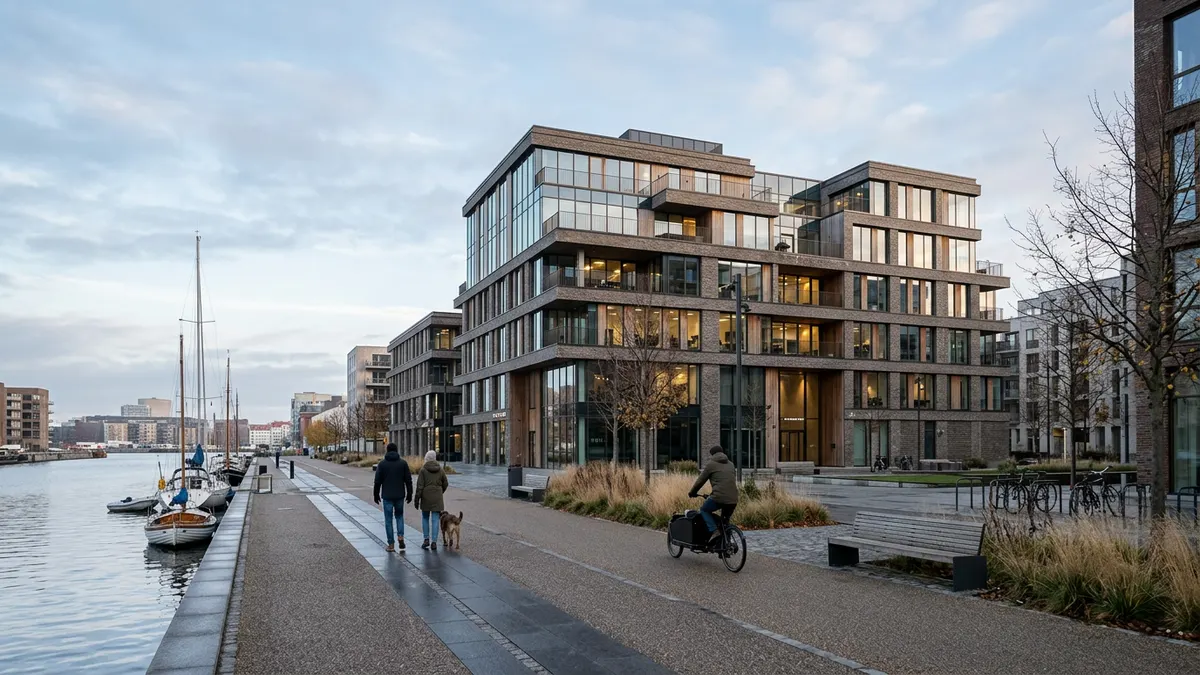
The choice between mortgage credit and bank financing for properties depends on the property type, time horizon, and the investor's capital structure. Mortgage credit is often the cheapest long-term solution for residential rental properties with up to 80% LTV, while bank financing provides necessary flexibility for short-term projects, renovation tasks, or as a supplement (top-up financing) to mortgage credit in growth areas such as Copenhagen, Aarhus, and Odense.
Basics of Financing Investment Properties in Denmark
When entering the Danish property market as an investor, the financing structure is often the single factor with the greatest impact on the total Return on Equity (ROE). The Danish financial system is unique globally, primarily due to the efficient realkreditsystem (mortgage credit system) based on match-funded bonds. This gives investors access to cheap, long-term capital that is rarely matched in other European countries.
However, mortgage credit is not always the answer to every need. Especially regarding bank financing for properties, a more nuanced approach is required. Where mortgage credit institutions operate within very strict legal frameworks set out in the realkreditloven (Mortgage-Credit Loans and Mortgage-Credit Bonds Act), banks have a greater degree of freedom to assess individual cases, the investor's overall portfolio, and the specific potential of a given project.
In September 2026, we see a market where the balance between stability and flexibility is crucial. Following years of fluctuating interest rates, understanding when to commit to a 30-year mortgage solution and when to choose a more agile bank solution has become a core competence for the serious investor.
The Mortgage Credit Loan: The Danish Foundation
A realkreditlån (mortgage credit loan) is for many synonymous with property investment in Denmark. The principle is simple: the mortgage institution provides a loan against a mortgage on the property, and this loan is financed by issuing bonds. This means the interest rate follows the market rate on bonds directly, plus a bidrag (administration margin) to the institution.
For commercial and rental properties, the maximum loan limit is typically 80% for residential rentals and 60% for most types of commercial property (office, warehouse, retail). In certain cases, the limit for industrial and workshop properties may be lower. It is important to note that this percentage is calculated based on the institution's valuation of the property—not necessarily the purchase price.
Advantages of Mortgage Credit
- Low Interest Rates: As the loan is secured by highly secure negotiable bonds, the rate is typically the lowest available on the market.
- Long Maturity: Possibility of up to 30 years maturity, creating predictability in the operating budget.
- Transparency: Price formation is public, and administration margins are relatively standardised, though they vary by LTV and property type.
Disadvantages of Mortgage Credit
- Rigidity: Mortgage institutions are subject to strict legal requirements. If a property is facing extensive renovation and is therefore empty, it can be difficult to obtain full mortgage leverage from day one.
- Loan Limits: You can rarely finance the entire acquisition price, leaving a gap that must be covered by equity or other financing.
Bank Financing of Properties: Flexibility and Speed
Bank financing of properties works fundamentally differently. Here, the bank lends money directly from their own deposits or by borrowing on the interbank market. This allows the bank to engage in an individual dialogue with the investor that goes beyond mere property value.
The bank often looks at the "big picture." This includes the investor's experience, liquidity reserves, and the specific business plan for the property. If you buy a property in a growth city like Roskilde or Vejle for rapid optimisation and resale (fix-and-flip or value-add), a bank solution will often be more attractive despite a higher interest rate.
When is the Bank the Right Choice?
Bank financing is often necessary in the following scenarios:
- Top-up Financing: When mortgage credit covers the first 60-80%, the bank can cover the next 10-15%, reducing the investor's equity requirement.
- Project Financing: For new builds or total renovations where the property does not yet generate cash flow.
- Short-term Loans: If the property is to be sold within 12-24 months, the costs of establishing and redeeming mortgage loans (kurtage (brokerage), tinglysning (registration), and price risk) may exceed the interest savings.
- Out-of-category Properties: Certain types of properties that mortgage institutions find difficult to value or do not wish to lend against due to risk can often be financed in a local or specialised commercial bank.
Comparison of Financing Forms
To provide an overview of the most significant differences, we have set up the table below comparing the two primary sources of capital in the Danish market.
| Parameters | Mortgage Credit Loan | Bank Financing |
|---|---|---|
| Primary Security | First priority mortgage | Mortgage and often personal guarantee/floating charge |
| Interest Level | Low (Market rate + margin) | Medium to high (Variable rate + risk premium) |
| Maturity | Typically 20-30 years | Typically 1-10 years or as a credit line |
| Flexibility | Low (Standardised products) | High (Individual agreements) |
| Loan Limit | Up to 60-80% of value | Can go higher as top-up financing |
| Principal | Fixed at issuance | Can often be a drawing right (overdraft) |
Geographical Differences in Lending Appetite
In Denmark, geography is a significant factor in how bank financing of properties and mortgage credit are priced. Financial institutions perform a risk assessment based on the property's location, also known as "A, B, C, and D locations."
Copenhagen and Aarhus (A-locations)
In the largest cities, demand for rentals is stable, and the risk of vacancy is historically low. Here, mortgage institutions are very willing to reach maximum loan limits. Banks are equally aggressive in their pricing of top-up financing, as the security in the property value is considered high.
Growth Cities like Odense and Aalborg (B-locations)
These cities have seen significant growth in recent years. We often see a combination where mortgage credit takes the majority share, but where bank financing plays a key role in financing new student housing or conversion projects of older commercial buildings.
Regional Hubs and Rural Areas (C and D-locations)
Moving outside the major growth centres to smaller towns in areas like West Jutland or Lolland-Falster, the picture changes. Mortgage institutions may be more conservative in their valuation (forsigtighedsprincippet (the principle of prudence)). Here, local bank financing becomes crucial. A local bank often has better knowledge of the specific area and can assess risk more accurately than a central valuer from a large mortgage institution in Copenhagen.
Anatomy of a Credit Assessment: What Does the Bank Look For?
When you apply for bank financing for your properties, it is not just the bricks and mortar being assessed. The bank performs a comprehensive credit assessment, typically resting on three pillars:
1. Property Cash Flow (Operations)
The bank analyses the property's ability to service the debt. They look at rental income, operating expenses, maintenance budgets, and a realistic vacancy factor. They often calculate a gældsdækningsgrad (Debt Service Coverage Ratio - DSCR), which shows how many times the annual operating profit can cover interest and principal payments.
2. Investor Profile and Experience
If you are an experienced property developer with a history of successful projects in Silkeborg or Randers, the bank will be more inclined to offer favourable terms. For new investors, a higher degree of transparency and perhaps higher equity is often required.
3. Exit Strategy
Especially with short-term bank financing, the bank is very concerned with how the loan will be repaid. Is the property to be refinanced with a mortgage loan after renovation? Is it to be sold as a project property? A clear and documented exit strategy is essential to get your bank financing approved.
Tax, Law, and Regulatory Frameworks
It is important to emphasise that rules for financing and taxation of properties are complex and subject to ongoing changes from authorities such as SKAT (the Danish Tax Agency) and Finanstilsynet (the Danish Financial Supervisory Authority). For example, the FSA's guidelines on prudence in credit assessments significantly impact how much banks may lend to property projects.
Investors should always seek advice from specialised accountants and lawyers to ensure the chosen financing structure is optimal relative to current legislation, including rules on interest deduction limitation and corporate structures (e.g., holding companies vs. personally owned businesses).
Note: This article does not constitute legal or tax advice. Always contact a professional advisor before significant investment decisions.
Strategic Composition of Financing
The most successful investor is rarely the one using only one type of financing. Instead, we see a trend towards "hybrid models." Here, one utilises the stability of mortgage credit as a foundation (senior debt) and supplements with bank financing or mezzanine capital to lift the higher-risk parts of the project.
For example, an investor might buy an older rental property in Kolding:
- Phase 1: The bank provides a short-term loan for purchase and renovation.
- Phase 2: The property is refurbished, and rent is optimised.
- Phase 3: The property is re-valued by a mortgage institution. As the value is now higher, the mortgage loan can cover the entire original bank loan and perhaps even release some of the investor's equity for the next project.
This cycle is the engine in many property portfolios, but it requires close cooperation with both bank and mortgage partners.
The Interest Rate Market and Its Influence
In September 2026, the interest rate market is characterised by normalisation after previous years' fluctuations. This makes the choice between fixed and variable rates central.
- Mortgage Credit offers the option of a fixed rate for 30 years, providing maximum budget security.
- Bank Financing is almost always variable-rate, typically based on a reference index like CIBOR3 plus an individual margin.
If you expect falling rates, bank financing or variable mortgage credit may be attractive. Conversely, if you want to sleep soundly at night and protect your equity against rate hikes, a fixed-rate mortgage loan is often the winner.
The Hidden Costs of Financing
When comparing bank financing with mortgage credit, one must not focus blindly on the interest rate alone. There are several other costs to be included in the Annual Percentage Rate (APR):
- Establishment Costs: Fees to the bank or institution for creating the loan.
- Tinglysningsafgift (land registration fee): A state tax of 1.5% of the loan amount plus a fixed fee (2026 rates should be checked with the Land Registry Court).
- Brokerage and Price Loss: Particularly relevant for mortgage credit, where bonds are rarely traded at par (100).
- Bidragssatser (administration margins): An ongoing payment to the mortgage institution that can change during the loan term.
- Account Fees and Guarantees: Often occurring in bank relationships.
Summary and Recommendation
There is no single answer to what is best. For the conservative long-term investor buying fully developed properties with stable cash flow, mortgage credit will almost always be the foundation. For the dynamic investor who sees market opportunities requiring quick action, or who operates in niches where standard models do not fit, bank financing for properties is an indispensable tool.
It is always recommended to obtain quotes from multiple sources and present your project with a thorough business case, including sensitivity analyses (what happens to returns if interest rates rise by 2%?).
Frequently asked questions
What is the biggest difference between bank loans and mortgage credit for business?
The biggest difference lies in the security provided and the source of funding. Mortgage credit is based on bonds and has strict legal frameworks for lending, while bank loans are more flexible but often more expensive, based on the bank's own funds and an individual credit assessment.
Can I get 100% financing for an investment property?
It is very rarely possible to obtain 100% external financing in the current market (2026). Typically, between 15-25% equity is required. In some cases, a higher total leverage can be achieved by combining mortgage credit, bank loans, and potentially seller notes or mezzanine capital.
Why is the administration margin on mortgage loans different?
The bidragssats (administration margin) depends on the property type (e.g., office is more expensive than residential rental) and your LTV. The higher the leverage, the higher the risk for the institution, which is reflected in a higher margin.
Is it harder to get financing for properties outside the major cities?
Yes, generally financial institutions require higher equity or offer lower LTV in areas with less liquid property markets to mitigate the risk of value loss and vacancy. Here, local bank relationships often play a decisive role.
How PropertyInvestments can help
Since 1985, PropertyInvestments has helped investors navigate the Danish property market. We source and set up investment properties so they are ready for financing and operation. We understand the importance of a correct capital structure and can assist in preparing the necessary data foundation that banks and mortgage institutions require for a positive credit assessment. Whether you are seeking residential rental properties in growth centres or commercial spaces for optimisation, our experience ensures a professional process from sourcing to final sale. Contact us for a non-binding dialogue about your options as an investor.
Contact Information: Email: info@propertyinvestments.dk Phone: +45 31 16 31 00